Introduction: Tracking in AI Mode (and why beginners should care)

I started noticing a strange disconnect about six months ago. My traditional rankings for a core set of keywords were stable—some had even moved up a spot—but our click-through rate was bleeding out slowly. It wasn’t a technical glitch. It was ChatGPT and Google’s AI Overviews.
For years, we chased blue links. Now, users are getting full answers before they even click. The problem isn’t that SEO is dead; it’s that the measurement stick we’ve used for twenty years—ranking position—is suddenly half-blind. If an AI summarizes your product perfectly but doesn’t link to you, or worse, hallucinates a feature you don’t have, your Google Search Console won’t tell you.
This is where we stand today. You need visibility inside the black box. In this guide, I’m going to strip away the hype and walk you through the practical reality of tracking AI visibility. We’ll look at the tools that actually work, how to set up a monitoring workflow that won’t eat your entire week, and how to protect your brand when the answers are generated, not indexed.
What you’ll learn in the next 10 minutes
- The specific metrics that replace ‘rank’ in an AI world (citations vs. mentions).
- A realistic comparison of top tools like PromptRush, SE Ranking, and emerging players like Waikay.io.
- How to build a prompt library that mimics real buyer questions.
- A step-by-step workflow to detect hallucinations and optimize content.
Why AI visibility is becoming essential for SEO (AEO/GEO in plain English)

Let’s get the definitions out of the way so we can focus on the work. You’ll hear terms like Answer Engine Optimization (AEO) or Generative Engine Optimization (GEO). Don’t let the acronyms intimidate you. They simply describe the shift from optimizing for a search engine’s index to optimizing for a generative engine’s output.
Think of AI answers as a new, aggressive “featured snippet” layer. If a user asks, “What is the best project management software for small businesses?”, the AI generates a synthesized recommendation. If you aren’t part of that synthesis, you don’t exist to that user. Some projections suggest AEO strategies could reduce reliance on traditional SEO significantly by 2026 , but even if that timeline is aggressive, the trend is undeniable.
For US-based SaaS companies and local service businesses, this is critical. It’s about brand trust and demand capture. If Perplexity or Gemini answers a query about your industry and strictly cites your competitors, you are losing leads that are high-intent and ready to buy.
FAQ-style quick definition: What is an AI-powered rank tracking tool?
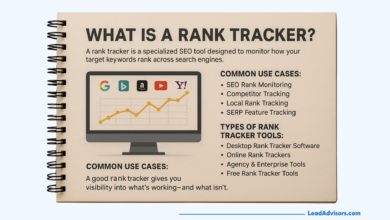
An AI-powered rank tracking tool is software designed to monitor your brand’s visibility within generative AI responses (like ChatGPT, Claude, or Google AI Overviews) rather than just tracking positions on a traditional search results page. It tells you if you were mentioned, if you were cited as a source, and the sentiment of that mention.
How AI-based rankings actually work: prompts, citations, sentiment, and “memory”

Tracking AI isn’t as clean as tracking Google. In traditional SEO, you are either at position #1 or you aren’t. In AI, results vary based on the model’s “temperature” (creativity), user history, and updates. To track this, we need a new vocabulary.
Here are the terms you need to know:
- Prompt-level tracking: Monitoring specific questions users ask (e.g., “Is X better than Y?”).
- Citations: When the AI explicitly links to your URL as a source.
- Share of Voice (SOV): How often your brand appears compared to competitors for a set of prompts.
- Sentiment Analysis: Is the AI speaking positively, negatively, or neutrally about you?
- Hallucination Detection: Identifying when the AI invents facts about your brand.
- Memory/Recall Decay: A newer metric measuring how long a brand stays “top of mind” in a model before fading out.
For example, if I ask ChatGPT regarding email tools three times, it might give slightly different phrasing each time. Good tools account for this by sampling—running the prompt multiple times to give you an aggregate “confidence” score. Expect some variance; it’s the nature of the beast.
Prompt-level vs keyword-level tracking (and when each wins)
This is the first decision you’ll make. Keyword tracking injects your keywords into generic templates, while prompt tracking uses exact phrases you define.
My rule of thumb: If you are in PR or Brand Monitoring, use prompt tracking to see exactly how you are described. If you are doing content planning at scale, use keyword-level tracking to cover more ground efficiently.
The AI engines most tools cover (what to look for)
Don’t assume every tool tracks every robot. Commonly supported engines currently include ChatGPT (various versions), Google Gemini, Claude, Perplexity, Microsoft Copilot, and Google AI Overviews. For the US market, ensuring strong coverage of Google AI Overviews and ChatGPT is usually the baseline requirement.
Comparing the best AI-powered rank tracking tools in 2025–2026 (what each is good for)

The market has split into two camps. First, you have the Hybrid SEO Suites—the incumbents like Ahrefs and Semrush who have bolted on AI visibility features. Then, you have the AI-Native (GEO) Tools—platforms built from scratch specifically to dissect LLM responses.
The hybrids are great if you want to keep everything in one dashboard. Ahrefs’ Brand Radar and Semrush’s AI Toolkit are excellent for seeing AI Overviews alongside your backlinks. However, the AI-natives often go deeper. Tools like PromptRush and RankScale were designed to track detailed prompt variations and sentiment shifts that traditional crawlers sometimes miss.
We are also seeing specialized entrants like Waikay.io (launched March 2025) which focuses heavily on entity trust and hallucination detection, and Otterly.ai, which partnered with Semrush in early 2025 to bring accessible AI monitoring to the mass market. Emerging enterprise tools like AIVisibility Pro are even offering recall volatility tracking to see how quickly a model “forgets” you.
Table: Tool snapshot (coverage, depth, best use case, starting price)
Note: Pricing and features change rapidly in this sector. Verify on vendor sites.
| Tool Name | Type | Best For | Standout Feature | Est. Starting Price |
|---|---|---|---|---|
| SE Ranking | Hybrid | Agencies / SMBs | AI Visibility Tracker with Share of Voice | ~€59/mo (Add-on) |
| Otterly.ai | AI-Native | SMBs / Starters | Budget-friendly prompt tracking | ~$29/mo (15 prompts) |
| Peec AI | AI-Native | Growth Teams | Deep prompt & citation analysis | ~€89/mo |
| RankFlow AI | AI-Native | SEO Managers | Correlating SERP with AI Mentions | ~$99/mo |
| RankScale | AI-Native | Experimenters | Flexible credit system & simulation | ~$20/mo (credits) |
| Waikay.io | Specialized | Brand Protection | Hallucination detection & Entities | Contact Vendor |
| Ahrefs / Semrush | Hybrid | General SEOs | Integrated Workflow | Standard Plan + Add-ons |
Hybrid vs AI-native tools: how I choose between them
Here is how I decide for clients. If you are a marketing manager at a SaaS startup with limited time, stick to a Hybrid tool like SE Ranking or Semrush. You already have the subscription, and the data is “good enough” to spot trends.
However, if you are a niche agency or a brand where reputation is everything (like legal or health), go AI-Native. You need the granularity of sentiment analysis and the ability to detect hallucinations that native tools provide.
My evaluation checklist for AI rank tracking tools (what to prioritize as a beginner)

If I only had $100/month to spend, I wouldn’t just buy the tool with the prettiest dashboard. I’d look for specific capabilities that actually help me improve my content. Start small—don’t try to track 500 prompts on day one. Start with 25 that really matter to your bottom line.
Checklist: the 8 criteria I verify before I pay
- Engine Coverage: Do they cover the engines my customers actually use? (Usually Google AIO and ChatGPT).
- Sampling Transparency: Do they tell you how many times they ran the prompt to get that result? Red flag if they don’t.
- Citation Detail: Does it just say “mentioned” or does it give the exact URL cited?
- Snapshot Storage: Can I see the actual screenshot or text of the answer from last week?
- Sentiment Analysis: Can it distinguish between a recommendation and a criticism?
- Export/API: Can I get this data into Looker Studio? (Vital for agency reporting).
- Update Frequency: Do they track daily, weekly, or on-demand?
- Hallucination Detection: Will it alert me if the AI says I offer a refund policy I don’t actually have?
Table: Must-have vs nice-to-have features (SMB vs enterprise)
| Feature | SMB / Individual | Enterprise / Agency |
|---|---|---|
| Prompt Volume | 25–50 Prompts | 500+ Prompts |
| Integrations | CSV / Excel Export | BigQuery / Tableau / API |
| Alerts | Weekly Email Digest | Real-time Slack Alerts |
| Recall/Decay | Nice to have | Must-have (Brand protection) |
| Multi-Location | Not usually needed | Essential for local franchises |
The AI Visibility Lifecycle workflow: set up, monitor, diagnose, optimize

Buying the tool is the easy part. The hard part is knowing what to do with the data. I use a framework called the AI Visibility Lifecycle. It keeps me from getting overwhelmed by daily fluctuations. Here is how you can implement it this week.
Step 1 — Build a prompt set that matches real buyer questions
Don’t just dump your keyword list into the tracker. Users talk to chatbots differently than search bars. Create a starter list of 15–20 prompts. For example, if you are in HVAC services, your list might look like:
- “What is the most reliable AC repair service in [City]?”
- “Compare Trane vs Carrier air conditioners for humid climates.”
- “How much does a new furnace installation cost in 2025?”
- “Who offers 24/7 emergency HVAC near me?”
Keep the wording consistent. If you change the prompt every week, you break your trend lines.
Step 2 — Track visibility signals that matter (mentions, citations, position, sentiment)
Set up your dashboard to log the basics. In my internal spreadsheet, I keep a simple schema:
Date | Engine | Prompt | Mentioned? (Y/N) | Primary Citation URL | Sentiment | Competitors Cited
I focus heavily on the “Primary Citation URL.” Being mentioned is vanity; being the clickable source is sanity. Note that “position” in AI is fuzzy—sometimes you are a bullet point, sometimes a footnote. Treat position as a general guide, not an absolute rank.
Step 3 — Detect problems: hallucinations, wrong facts, and recall/memory decay
Here is a scenario I’ve seen: A client’s brand was being recommended by ChatGPT, but it was listing their old pricing structure from 2022. That’s a “soft hallucination.”
When you spot this (using tools like Waikay.io or manual checks), you enter the “Recall Repair” mode. You need to identify where that bad data might be living on your site or third-party directories and update it. Then, monitor the “recall decay”—how long does it take for the model to update its answer? It might take weeks.
Step 4 — Optimize: content updates, entity signals, and citation targeting
Once you know where you are missing, you optimize. This usually means creating content that directly answers the specific prompt where you lack visibility. You need concise, authoritative answers that LLMs can easily parse.
This is often a volume game. You might identify 20 prompts where you have zero presence because you lack specific articles covering those nuances. To execute this quickly, using an AI article generator can help you produce high-quality, intent-matched drafts that you can refine and publish to fill those gaps immediately.
Operationalizing it: dashboards, reporting cadence, and tying AI visibility to ROI

The quickest way to get fired is to report on AI volatility every single day. “Hey boss, we dropped out of ChatGPT today!” followed by “We’re back!” tomorrow creates panic, not confidence.
I recommend a weekly pulse check for yourself and a monthly deep dive for stakeholders. In your reporting, try to bridge the gap to revenue. While attribution is hard, you can correlate trends. “Our visibility in Perplexity rose 20% this month, and we saw a correlating lift in direct traffic and branded search.” It’s not perfect proof, but it’s a strong signal.
To scale this execution, you need a stack that doesn’t just track, but helps you act. Think of an AI SEO tool not just as a monitor, but as a content intelligence partner that helps you create the assets required to win that visibility back.
Template: the one-page AI visibility report I’d send to stakeholders
- Executive Summary: “We are present in 60% of target AI conversations, up 5% from last month.”
- Top Wins: 3 specific prompts where we gained citations.
- Critical Issues: Any hallucinations or negative sentiment detected (and the fix in progress).
- Competitor Movement: “Competitor X is dominating queries about [Topic].”
- Action Plan: The 3 pieces of content we are refreshing this week to address gaps.
Common mistakes, fixes, and quick FAQs (so you don’t waste budget)
I see a lot of teams burning budget on tools they don’t know how to use. The most common mistake? Tracking too much, too soon. If you track 500 keywords across 5 engines daily, you will drown in data and run out of credits in a week.
Mistakes I’d avoid (and what I’d do instead)
- Mistake: Obsessing over daily fluctuations.
Fix: Look at 14-day trend lines. Ignore the noise. - Mistake: Ignoring the cited sources.
Fix: Click the citations! If the AI cites a specific blog post of yours, optimize that post further. - Mistake: Failing to produce content at scale.
Fix: You know what content is missing, but you can’t write it fast enough. Use an Automated blog generator to build the initial drafts for your missing topic clusters, then have a human editor polish them. - Mistake: Forgetting about brand entities.
Fix: Ensure your “About Us” and homepage clearly define who you are and what you do in simple language. - Mistake: Not segmenting by engine.
Fix: Realize that Google AIO and Claude have different “personalities.” Optimize for the one that drives your traffic.
Quick FAQs
What is an AI-powered rank tracking tool?
Simply put, it’s a tool that tracks your brand’s presence in AI chatbots. Unlike traditional SEO tools that check Google’s blue links, these tools simulate user prompts in models like ChatGPT and Gemini to see if you are mentioned or cited.
Why are these tools becoming essential for SEO strategies?
Because search behavior is changing. As more users rely on AI Overviews or chatbots for answers, traditional click-through rates are declining. If you aren’t visible in the AI answer, you are invisible to a growing segment of buyers.
How do hybrid tools differ from AI-native tools?
Hybrid tools are existing SEO platforms (like Ahrefs) that added AI tracking as a feature. AI-native tools (like PromptRush) were built specifically for LLMs. Choose hybrid for convenience, or native for deeper insights like prompt-level sentiment.
Which factors should businesses consider when choosing a tool?
Look for engine coverage (do they track the ones you care about?), cost per prompt (it adds up fast), and the ability to detect hallucinations. Also, check if they offer an API if you plan to build custom dashboards.
Are these tools suitable for small businesses or only enterprises?
There is a tool for every budget. SMBs can start with tools like Otterly.ai or entry-level plans from SE Ranking. You don’t need an enterprise budget to start tracking your top 20 brand prompts.
Conclusion: my next-step checklist for tracking AI-based rankings
We are in a transition period. You don’t need to throw away your traditional rank tracker, but you can no longer ignore the AI layer. The winners in 2026 will be the brands that learned to speak the language of Large Language Models today.
Here is your plan for this week:
- Pick 15 Prompts: Don’t overthink it. Choose the questions your sales team gets asked every day.
- Choose One Tool: Sign up for a trial of a tool like Otterly (if budget is tight) or use the AI add-on in your current SEO suite.
- Set a Baseline: Run the tracking once to see where you stand. Are you mentioned? Are you cited?
- Fix One Thing: Find one prompt where a competitor is cited and you aren’t. Read their cited article, write a better one, and publish it.
It’s time to get to work.