Introduction: why “position in Google” now includes AI Overviews (and who this guide is for)

When I audit a site, I don’t start with “What’s my #1 keyword?” anymore. I start with a much messier question: “What SERP am I actually showing up in?”
For years, rank tracking was simple math. You were position 1, 3, or 10. But in 2026, a “#1 organic ranking” might be buried under a massive AI Overview, a sponsored block, and a local map pack. If you are reporting strictly on blue-link positions to your stakeholders, you aren’t lying, but you aren’t telling the whole truth either. The traffic doesn’t match the rank because the visibility has shifted.
This guide isn’t a sales pitch for a specific tool. It’s an operational breakdown for SEO managers, agency owners, and in-house marketers who need to justify their budget. I’m going to explain exactly what to track (traditional rankings vs. AI visibility), which tools handle the heavy lifting, and how to build a reporting workflow that focuses on revenue rather than vanity metrics.
What I track in 2026: rankings, SERP features, and AI visibility (the new baseline for best SEO rank tracking tools)

If you take nothing else from this article, let it be this: Position does not equal visibility. You can hold a stable position 3 while your click-through rate plummets because an AI Overview (AIO) is now answering the user’s question directly on the results page.
To get a real picture of performance, my tracking baseline has expanded. Here is what I monitor:
- Traditional Organic Rank: The classic blue link position. Still vital for navigational and transactional queries.
- SERP Features: Featured snippets, People Also Ask (PAA), and Local Packs. Tools like STAT now support tracking of more than 75 different SERP features, which is critical because these features often steal clicks from the #1 organic slot.
- AI Visibility: This is the new frontier. It answers: Is my brand mentioned in the AI Overview? Is my content cited as a source?
- Share of Voice (SoV): A weighted metric that tells you how much actual real estate you own compared to competitors.
Think of it this way: Traditional tracking tells you where you rank; AI visibility tracking tells you if you are part of the conversation. If I search “tax CPA near me” on my phone versus my desktop, or in Austin versus Dallas, the “winner” changes completely. If you aren’t tracking these nuances, you are flying blind.
Traditional rank tracking vs AI visibility tracking: what changes (and what doesn’t)

It’s easy to get confused by the terminology, so let’s simplify it. Traditional rank tracking asks: “If a user searches for X, does my website appear in the list of links?” It is linear and relatively stable.
AI visibility tracking asks: “If a user asks an AI (like Google’s Gemini or ChatGPT) a question, does the generated answer mention my brand or use my data?” This is harder to measure because LLMs (Large Language Models) are non-deterministic—they might phrase the answer differently each time. When we look at tools later, you’ll see that traditional tracking is about precision, while AI tracking is about presence.
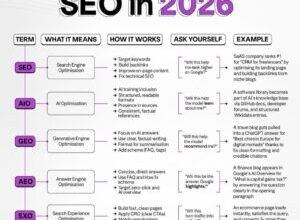
AEO/GEO basics: why Generative Engine Optimization affects what shows up in AI Overviews

Generative Engine Optimization (GEO) is the practice of optimizing content specifically to be picked up by AI summaries. It’s not a replacement for SEO; it’s an evolution of it. I look for clear entity definitions, direct answers to questions, and authoritative citations.
The goal isn’t to “hack” the LLM—that’s a losing game. The goal is to structure your information so clearly that the AI engine finds it easier to cite you than to ignore you. If your content is unstructured or fluffy, you might rank #4 organically but be completely excluded from the AI Overview.
The core metrics checklist (beginner-friendly)

Don’t try to track everything immediately. If you are setting up a dashboard today, start with this minimum viable list:
- Average Position by Keyword Group: Don’t obsess over single keywords; look at the trend for “commercial intent” vs. “informational intent” groups.
- Visibility Score / Share of Voice: An aggregate score of how visible you are across all tracked keywords.
- Local Pack Presence: Are you in the “Map Pack” for local queries?
- AI Overview Appearances: A simple count of how often an AIO triggers for your keywords and if you are cited.
- Update Frequency: Weekly is usually fine for SMBs; daily is necessary for news or highly volatile industries.
Note: Don’t panic when you see daily volatility. US markets are noisy. I look for 3-week trends, not 24-hour spikes.
How SEO rank trackers actually work (so I can trust the numbers)

I’ve had clients ask, “Why does this tool say I’m #5, but I see myself at #2?” The answer usually lies in how rank trackers work versus how your browser works.
Rank trackers use localized, depersonalized sessions. They query Google as if they were a user in a specific ZIP code, with no browsing history and no cookies. When you check manually—even in Incognito mode—Google often still uses your IP address or device fingerprint to tailor results. I once spent an hour debugging a ranking drop only to realize the client was checking from their office Wi-Fi, which Google had personalized heavily.
However, trackers aren’t perfect. Google has made it harder to track deep results (pages 2 through 10) by removing parameters like &num=100 (which used to force Google to show 100 results at once). This means many modern tools prioritize the top 20 results. For 95% of business decisions, this is fine—if you aren’t on page one, you barely exist anyway. But if you are doing deep cleanup work, you need to know your tool’s limitations.
Why rankings differ by city, ZIP code, and device (US examples)
Location granularity is the single biggest differentiator in tool quality. If you are a national brand, a “US – National” setting is fine. But if you run a franchise, it’s useless.
Imagine searching for “best pizza.” In Brooklyn, NY (11201), the results are completely different from Queens, NY (11101)—and they should be. Furthermore, mobile results often prioritize map packs and “click-to-call” features that push organic links down. If your tracker isn’t set up to distinguish between Mobile-Austin and Desktop-Austin, you are looking at an average that doesn’t exist in reality.
Tracking depth after Google SERP changes: can tools still go past page one?
This is a time-sensitive issue. As of late 2025/2026, Google’s architecture changes have made it resource-intensive to scrape deep rankings. Many tools now stop at position 20 or 50 by default to save resources. Some, like SE Ranking, still offer options to track up to page 50 or 100, and Ahrefs has adapted its collection methods. But in my experience, I verify deep rankings manually before making big strategic shifts based on them.
Best SEO rank tracking tools (2026): my comparison table + the right pick for your business
Choosing a tool usually comes down to budget versus granularity. I evaluate these based on accuracy, update frequency, and whether they can actually see AI Overviews. Tracking tells me what changed; content intelligence from platforms like Kalema helps me decide what to update and how to structure the revision. But first, you need the data.
Here is how the top players stack up in the current market.
How I scored the tools (criteria you can copy)
When I’m choosing a tool, I’ll trade fancy charts for reliable location tracking every time. Here is my rubric:
- Accuracy & Geo-Precision (Must-have): Can it track by ZIP code?
- AI/AIO Detection (Must-have for 2026): Does it tell me if an AI Overview is pushing me down?
- Update Frequency: Is it daily or weekly?
- Reporting: Can I automate a PDF to my boss/client?
- Price-to-Volume: Cost per keyword tracked.
Comparison table: traditional rank tracking + AI visibility (AIO/GEO) side by side
| Tool | Best For | Trad. Tracking Depth | AI/AIO Support | Key Limitation |
|---|---|---|---|---|
| Ubersuggest | SMBs & Budget Conscious | High (Top 100) | Basic AI Insights | Less granular for enterprise scale |
| SE Ranking | Agencies & Mid-Market | High (Up to Pg 50-100) | Strong (AI Visibility Tracker) | Historical data limits on lower tiers |
| Rankmint | AI Visibility Specialists | Standard | Weekly tracking (ChatGPT/Gemini) | Newer player, focused on AI niche |
| STAT | Enterprise / Big Data | Deep (All SERP features) | Advanced Share of Voice | Expensive; steep learning curve |
| Nightwatch AI | Local SEO / Multi-location | High (Zip code level) | Good (Volatility forecasting) | Interface can be complex for beginners |
Best budget-friendly options (SMBs and solo marketers)
If you are running a small site or a side hustle, you don’t need enterprise firepowers. Ubersuggest leads the pack for 2026 simply because it balances accuracy with affordability. It gives you the necessary daily updates without the enterprise price tag.
ProRankTracker is another solid option if you just want raw data without the bells and whistles. SE Ranking is my personal favorite “bridge” tool—it’s cheap enough for freelancers but powerful enough for agencies. If you are brand new, I’d rather you track 50 keywords consistently on a cheaper tool than blow your budget on a tool you don’t know how to use.
Best for local SEO and multi-location tracking (US agencies and franchises)
For agencies managing franchises (think: a dentist with 5 locations), Nightwatch AI is exceptional. Its ability to track specific map pack rankings across different ZIP codes is vital. I also lean on SE Ranking here for their local reporting capabilities.
Workflow Tip: For a local client, I track their core service keywords (e.g., “emergency plumber”) across 3-5 specific ZIP codes surrounding their office, specifically on mobile devices.
Best for enterprise scale (Share of Voice + SERP features)
When you are managing thousands of pages, you need STAT. It tracks over 75 SERP features and handles the sheer volume of data required to calculate a true “Share of Voice.” It’s overkill for a blog, but essential for a retailer.
For specific AI visibility at an enterprise level, tools like Peec AI, HallAI, and ScrunchAI are emerging to monitor brand appearances in AI responses. Just be warned: enterprise tools require governance. You need someone on your team dedicated to managing the data, or it just becomes expensive noise.
AI Overviews + AI visibility tools: what they can (and can’t) tell you
This is where things get tricky. Tools like Rankmint and Evertune AI are pioneering the tracking of mentions within ChatGPT and Gemini. They can tell you if your brand was recommended in an answer.
However, I treat this data as directional. An LLM answer isn’t static like a search result. It varies based on the prompt. These tools use standardized prompts to gauge your “likelihood” of appearing. Use them to spot opportunities to improve your entity authority, but don’t report them as absolute “rankings” to your boss yet.
My step-by-step workflow to track rankings and turn insights into wins (including AI Overviews)
Buying the tool is the easy part. Building a system that actually improves your traffic is the work. Here is the exact workflow I use to turn data into action.
Step 1: choose keywords that match business outcomes (not vanity terms)
I learned this the hard way: I once tracked 500 keywords for a client, and they panicked when obscure terms dropped. Now, I stick to a “Money + Context” list.
- Money Keywords (10-20): Terms that drive leads (e.g., “SEO software pricing”).
- Context Keywords (10-20): Informational terms that build authority (e.g., “how to track seo rankings”).
Group these in your tool using tags. If your “Money” group drops, it’s an emergency. If your “Context” group fluctuates, it’s just Tuesday.
Step 2: set location/device, competitors, and SERP features (the settings most beginners miss)
Default settings are the enemy. Always set your location to your primary market (e.g., “United States” or “Chicago, IL”). I recommend tracking Mobile as the primary device for most B2C businesses.
Crucially, enable Competitor Tracking. Tracking your own rank in a vacuum is useless. You need to know that you dropped to #4 because Competitor X jumped to #2.
Step 3: build a simple dashboard + reporting cadence (weekly/monthly)
If you only have 15 minutes a week, check these three things in your dashboard:
- Visibility Trend: Is the line going up or down over the last 30 days?
- Top Winners/Losers: Which specific pages moved the most?
- Cannibalization: Are two of your pages fighting for the same keyword?
Most tools allow you to export this to Looker Studio. I set up an automated email report for Monday mornings so I don’t have to log in to see the health of the account.
Step 4: turn movement into actions (content, internal links, technical fixes)
Data without action is just trivia. Here is my logic tree:
- Dropped 2-3 spots? The intent might have shifted. Check the SERP. If competitors have better headers or updated stats, I need a content refresh.
- Stuck on Page 2? The content is good but lacks authority. I need to add internal links from high-authority pages on my site.
- Missing from AI Overview? My content might be too unstructured. I need to add clear definitions and entity-rich text.
This is where content intelligence comes in. Once I know which page is failing, I use tools like Kalema’s AI article generator capabilities to help draft the optimized sections or restructure the content to meet the new user intent. No tool guarantees rankings—use insights to test improvements, then measure the results.
Common rank tracking mistakes I see (and how I fix them)
I’ve made every mistake in the book. Here are the ones that cause the most headaches, so you can avoid them.
- Obsessing over daily volatility: Rankings bounce. It’s normal. If I see a drop on Tuesday, I wait until Friday before I touch anything. Fix: Look at 7-day or 30-day averages.
- Ignoring the “Local Pack”: You might be #1 organically but invisible because the Map Pack pushes you down the page. Fix: Ensure your tracker is set to monitor “Local Pack” positions separately.
- Tracking the wrong URL: Sometimes a blog post ranks for a homepage keyword. This is cannibalization. Fix: Set “Target URL” in your tracker so it alerts you if the wrong page is ranking.
- Treating AI visibility as a stable rank: Clients get angry when ChatGPT mentions them one day and not the next. Fix: frame AI visibility as a “Share of Conversation” percentage, not a fixed rank.
- Forgetting Mobile vs. Desktop: I once audited a site that was #1 on desktop and #50 on mobile due to speed issues. Fix: Always track both if your traffic is mixed.
FAQs: best SEO rank tracking tools, AI visibility, and tracking beyond page one
What is the difference between traditional SEO rank tracking and AI visibility tracking?
Traditional tracking monitors the position of your website’s link on a Search Engine Results Page (SERP). AI visibility tracking measures whether your brand or content is mentioned within AI-generated responses (like AI Overviews, ChatGPT, or Gemini). Traditional tracking measures clicks; AI tracking measures citations and brand awareness.
Which tools are best for budget-conscious users?
For 2026, Ubersuggest is widely considered the best value for money, offering robust tracking and AI insights at a lower price point. ProRankTracker and SE Ranking (entry tiers) are also excellent choices for freelancers and SMBs who need accurate data without enterprise costs.
Which tools are geared toward enterprises?
STAT is the industry standard for large-scale tracking, capable of monitoring thousands of keywords and SERP features daily. For AI-specific enterprise needs, tools like Peec AI, HallAI, and ScrunchAI offer specialized monitoring of brand presence in Large Language Models.
Can keyword tools track rankings beyond page one given changes like Google’s removal of #num=100?
It is harder than it used to be. Google’s removal of the &num=100 parameter limits easy access to deep results. While many tools now focus on the top 20 or 50 results, advanced tools like SE Ranking and Ahrefs have developed workarounds to track deeper, though it’s often slower or more resource-intensive. For most users, top 20 tracking is sufficient.
What is Generative Engine Optimization (GEO)?
GEO is the process of optimizing content to increase the likelihood of being cited in AI-generated answers (like Google’s AI Overviews). It involves focusing on authority, clear structure, direct answers, and technical readability so that AI models can easily parse and reference your content.
Conclusion: my 3-point recap + next actions to start tracking today
We’ve covered a lot of ground, but successful SEO usually comes down to simplicity and consistency. Here is your recap:
- Track Reality, Not Vanity: Your dashboard must include AI visibility and SERP features, not just blue links.
- Context is King: Use a tool that handles the granularity you need (Local vs. National, Mobile vs. Desktop).
- Action Over Observation: Use your tracking data to trigger specific content updates, not just to fill a weekly report.
If you do only one thing this week, pick one tool from the list (Ubersuggest or SE Ranking are great starting points), set up a project with just 20 core keywords, and let it run for a week. Don’t try to fix everything at once. Just start watching the trends. You can’t improve what you don’t measure.