SEO Forecasting Tools: Predicting the Future and Setting Growth Goals (Beginner Guide)
I still remember the first time a VP of Marketing looked me in the eye during a quarterly planning meeting and asked, “If I give you this budget, exactly how much revenue will SEO drive by Q3?”
My stomach dropped. I knew SEO takes time. I knew algorithms were volatile. But “it depends” wasn’t going to save my budget. I needed a number. More importantly, I needed a number I could actually defend without looking like I was guessing.
This article is for any SEO or marketing manager in that hot seat. It’s about moving from “gut feel” to data-backed planning using SEO forecasting tools. We aren’t looking for a crystal ball—those don’t exist, especially with the rise of AI search. We are looking for a defendable model that accounts for traffic, revenue, and the new reality of Answer Engine Optimization (AEO).
Here is how I build forecasts that keep stakeholders happy and goals realistic, including the specific tools and workflows I use to get there.
What SEO Forecasting Really Is (and What It Isn’t)

Let’s clear the air: forecasting is not predicting the future with 100% accuracy. If anyone tells you they know exactly where Google will rank a keyword in six months, run.
SEO forecasting is the process of estimating future outcomes—usually traffic, conversions, and revenue—based on data we already have. It’s about calculating the opportunity gap between where you are now and where you could be, assuming you execute your strategy correctly.
To build a model, you typically need these core inputs:
- Current Keyword Set: The terms you rank for and the ones you want to rank for.
- Search Volume & Seasonality: How many people search, and when they search.
- CTR Curves: The percentage of clicks you expect at position 1 vs. position 5. (Note: This is where things get tricky with AI Overviews).
- Conversion Metrics: Your current conversion rate and Average Order Value (AOV) or Lead Value.
When forecasting saves the day:
- Budget Justification: Proving that a $50k content investment could yield $200k in pipeline.
- Hiring Roadmap: Showing that you need a technical SEO specialist to unlock specific growth.
- Stakeholder Alignment: Setting expectations so leadership doesn’t expect overnight miracles.
A quick example: If I identify a keyword with 5,000 monthly searches where we rank in position 9, we might get ~2% of clicks (100 visits). If my model shows that moving to position 3 increases CTR to 10%, that’s 500 visits—a 400% increase. Multiply that by your conversion rate, and you have a business case, not just a rank goal.
What surprised me most when I started doing this wasn’t how accurate the rank predictions were, but how much seasonality and SERP features mattered. Sometimes ranking higher didn’t yield more traffic because a new Featured Snippet or AI overview stole the clicks. That’s why we model ranges, not absolutes.
Forecasting outputs I actually use: baseline, target, and stretch
I never present a single number. It’s too risky. Instead, I present three scenarios. Think of it like a weather forecast: there’s a chance of rain, a chance of sun, and a likely overcast day.
- Baseline (The “Do Nothing” Scenario): If we stop optimizing today, what happens? Usually, this shows a slow decline due to decay and competitor activity.
- Conservative Target (The “Safe Bet”): If we execute our plan but progress is slow (e.g., we hit position 5 instead of position 1), what do we get? This is the number I commit to.
- Stretch Goal (The “Blue Sky”): If everything goes perfectly—content ranks fast, backlinks stick, and CTR remains high—what is the maximum potential? This excites the sales team, but I explicitly label it as “aggressive.”
The minimum data I need to start forecasting
You don’t need a data science degree. You need messy, imperfect data, and that’s okay. Here is my minimum viable dataset:
- Google Search Console (GSC): For real impressions and current CTR.
- GA4 or CRM Data: For conversion rates by page type (blog vs. product page).
- Target Keyword List: A CSV of 50–500 keywords you actually care about.
- An Assumptions Log: A simple tab where you write down “Assumed 2% conversion rate” so you can change it later.
A Step-by-Step Workflow: Using SEO Forecasting Tools to Set Growth Goals

If I were walking a colleague through this on a shared screen, this is exactly the workflow I would demonstrate. It moves from business goals to content execution.
Step 1: Define the business goal first (not the traffic goal)
Don’t start with “I want 10,000 more visitors.” Start with “We need 50 more booked demos next quarter.”
Work backward. If you need 50 demos, and your site converts traffic to demos at 1%, you need 5,000 qualified visitors. Now you know exactly how much search volume and ranking improvement you need to hunt for. In the US market, where planning cycles are often quarterly, aligning your SEO forecast with the sales pipeline makes you look like a partner, not just a traffic chaser.
Step 2: Build a clean keyword universe (intent + funnel stage)
Dump your keywords into a spreadsheet or tool. I group them by intent: Informational (top of funnel, lower conversion) vs. Commercial/Transactional (bottom of funnel, higher conversion).
Pro tip: If you’re a beginner, don’t try to forecast 10,000 keywords. Pick your top 30–50 core money pages. It’s easier to manage and often represents 80% of the revenue impact.
Step 3: Choose assumptions: CTR, seasonality, and SERP reality
This is the hardest part. You have to assign a Click-Through Rate (CTR) curve. A standard curve might assume Position 1 gets 30% of clicks. But in 2025, with AI Overviews and ads, Position 1 might only get 15%.
I was wrong when… I once applied a generic CTR curve to a client in the travel industry. The model predicted massive traffic gains. In reality, the SERP was covered in ads, map packs, and “People Also Ask” boxes. We ranked #1, but traffic barely budged. Now, I always check the SERP features and downgrade my CTR assumptions for busy keywords.
Industry data suggests that by 2025, over 60% of mobile searches may result in no click . I treat this as a signal to be conservative. If the query is “What is the capital of France?”, assume zero clicks.
Step 4: Model scenarios (baseline vs conservative vs aggressive)
If you don’t have a fancy tool, use a spreadsheet. Column A: Current Rank. Column B: Current Traffic. Column C: Target Rank (Conservative). Column D: Target Traffic (Volume * Conservative CTR).
Don’t strive for perfection. The goal is to see the trend. Is the growth flat, linear, or exponential? This helps you decide if the effort is worth the reward.
Step 5: Turn the forecast into an on-page + content execution plan
A forecast is useless without a work plan. Once I see the opportunity, I map it to tasks:
- New Content: Which topics need net-new articles?
- Optimizations: Which existing pages need a refresh to move from pos 8 to pos 3?
- Technical: Do we need schema to capture rich snippets?
This becomes my content calendar. Every item on the calendar has a predicted dollar value attached to it from the forecast.
Step 6: Measure, report, and update the forecast monthly
Here is my sanity check habit: I never print a forecast and walk away. It is a living document. Every month, I pull the actuals and compare them to the projection.
If we are underperforming, why? Did we not publish enough? Did competitors outrank us? Did seasonality hit harder? I update the model quarterly to reflect the new reality. This builds trust because you aren’t hiding the bad news; you’re managing it.
Forecasting in 2025–2026: How AEO/GEO Changes What I Forecast

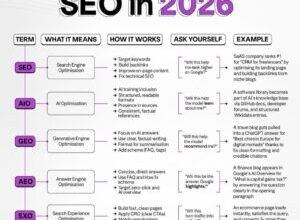
We can’t ignore the elephant in the room. Generative AI and Answer Engines (like Perplexity or SearchGPT) are changing the game. Traditional forecasting looks at clicks. But in an AEO (Answer Engine Optimization) world, success might mean visibility without the click.
Some projections suggest AEO could lead to a 20–40% decline in organic traffic for brands relying solely on traditional SEO links . That sounds scary, but I treat AI visibility as an additive layer.
In my recent planning, I’ve started tracking “Share of Model“—how often our brand is mentioned in AI answers—alongside traditional rankings. If traffic drops but brand search volume and direct sales hold steady, we know AEO is working. It changes the conversation from “Where are my clicks?” to “Are we influencing the answer?”
What distinguishes SEO forecasting tools from AEO/GEO tools?
Think of it like the difference between a GPS and a dashboard.
- SEO Forecasting Tools (The GPS): Tools like SEOmonitor or Ahrefs project where you are going. They calculate traffic and revenue potential based on rank positions and search volume.
- AEO/GEO Tools (The Dashboard): Emerging tools like Otterly.ai or Writesonic act as sensors. They tell you if you are showing up in ChatGPT’s answers or Google’s AI Overviews. They don’t necessarily predict future revenue yet, but they monitor current visibility in the new ecosystem.
The hybrid KPI set I recommend (traffic + visibility)
I advise clients to track a blended scorecard:
- Traditional: Non-branded organic traffic & keyword rankings.
- Business: Conversions & Revenue.
- New Age (AEO): Brand mentions in AI answers & “Zero-click” impressions (where the user saw you but didn’t need to click).
Choosing SEO Forecasting Tools: What to Look for + Tool Comparison Table

I’ve seen too many teams blow their budget on expensive enterprise suites before they even have a clear goal. If you are a beginner or intermediate SEO, start small.
When evaluating an AI SEO tool or forecasting platform, look for transparency. If the tool gives you a number but won’t let you see the math (CTR assumptions, seasonality inputs), don’t trust it. You need to be able to explain the “why” to your boss.
| Tool Category | Example Tools | Best For | Forecasting Depth | Beginner Friendly? |
|---|---|---|---|---|
| Dedicated Forecasting | SEOmonitor | Agencies & In-house teams needing precise, revenue-tied forecasts. | High (Includes seasonality & difficulty) | Yes (Great UI) |
| All-in-One Suites | Ahrefs / Moz / Semrush | General data gathering & quick traffic estimates. | Medium (Good for inputs, less for modeling scenarios) | Yes |
| AI Visibility (AEO) | Otterly.ai / Writesonic | Monitoring brand mentions in AI chat answers. | Low (Focus is on monitoring, not projecting) | Medium |
My criteria checklist (copy/paste)
Use this checklist when demoing software:
- Transparency: Can I customize the CTR curve?
- Seasonality: Does it account for holiday spikes?
- Scenarios: Can I easily toggle between “Conservative” and “Aggressive”?
- Integrations: Does it pull actual conversion data from GA4?
- Cost: Is it priced per keyword? (This scales up fast).
A simple decision tree: spreadsheet vs dedicated forecasting platform
Use a Spreadsheet if: You have fewer than 100 keywords, a limited budget, and you are the only one managing the SEO strategy.
Use a Dedicated Platform if: You manage 500+ keywords, report to a C-suite that demands visual charts, or manage multiple clients/regions where manual updates would take days.
How I Turn Forecasts Into Content That Performs (On-Page + Structured Answers)

A forecast is just a dream until you publish content. The data tells me what to write, but my process determines how it ranks. When I scaled my last project, I used an AI article generator to help create comprehensive briefs and first drafts based on the keyword clusters I identified in the forecast.
But simply publishing isn’t enough. To rank in 2026, you need to optimize for both the user and the AI engine.
On-page checklist: title, meta, headings, internal links
Here is the checklist I give to writers:
- Title Tag: Front-load the main keyword. Keep it under 60 chars. (Pitfall: Being too clever/vague hurts CTR).
- H1 & H2s: Structure the article logically. H2s should be questions users ask.
- Internal Links: Link to 3-5 relevant related pages. This isn’t just for SEO; it guides the user to conversion.
- Meta Description: Treat this as ad copy. Why should they click your result?
Schema and formats that help AI answers cite you
To capture AI visibility, formatting is everything. AI models love structure. I’ve found that using listicles, clear Q&A definitions, and tables increases the likelihood of being cited.
I also implement schema markup where relevant. While not a guaranteed ticket to an AI citation, FAQ Schema and HowTo Schema make your content machine-readable. It’s like handing the AI a summary card of your content so it doesn’t have to guess.
Common Forecasting Mistakes (and How I Fix Them)

I’ve made plenty of mistakes. The biggest one? Spending three days building a complex model that nobody looked at because it was too confusing. I lost time I could have spent optimizing.
| Mistake | Symptom | The Fix |
|---|---|---|
| Blind Optimism | Projecting linear growth forever. | Apply a “cap” to growth and use conservative CTRs. |
| Ignoring Seasonality | Panic when traffic drops in Q4 (for B2B). | Overlay last year’s traffic trend on your forecast. |
| Messy Inputs | Mixing brand and non-brand keywords. | Separate them! Brand traffic behaves totally differently. |
Mistake 1–3: Modeling errors that inflate projections
The most dangerous mistake is assuming that moving from Rank 5 to Rank 1 is easy. It gets exponentially harder. I fix this by capping my “Conservative” scenario at Rank 3 or 4. Also, watch out for seasonality. If you sell pool supplies, don’t forecast growth in December just because you optimized a page.
Mistake 4–8: Execution and measurement gaps
Forecasts fail when execution fails. If you planned 10 articles but only published 2, your model breaks. The fix? A simple monthly review. Check your velocity. If you are behind on publishing, adjust the forecast downward immediately. It’s better to lower expectations now than miss the target later.
FAQs: SEO Forecasting Tools, AEO/GEO, and Optimizing for AI Answers
What distinguishes SEO forecasting tools from AEO/GEO tools?
SEO forecasting tools (like SEOmonitor) predict future traffic and revenue based on search demand and rankings. AEO tools (like Otterly.ai) monitor your brand’s presence in AI-generated answers today. One plans the future; the other monitors the new AI layer.
Do traditional SEO forecasting tools still hold value?
Absolutely. Traditional search isn’t dead; it’s just sharing the stage. The majority of commercial intent still happens via search queries. Forecasting tools provide the baseline data you need to secure budget and track progress.
How can content creators optimize for AI-generated answers?
Focus on structure. Use direct answers to questions immediately after headings (e.g., “What is SEO? SEO is…”). Use lists, tables, and Schema markup (FAQ, HowTo) to help AI parsers understand and cite your content.
Which tools are useful for forecasting SEO growth?
For beginners, Ahrefs or Semrush provide great data inputs. For dedicated forecasting with revenue modeling, SEOmonitor is excellent. For monitoring AI visibility, look at Writesonic or Otterly.ai.
Conclusion: A Practical Forecasting Plan I’d Use This Month
Forecasting isn’t about being perfect; it’s about being prepared. By combining traditional data with a realistic view of AI search, you can set goals that actually make sense for your business.
Key Takeaways:
- Start with the business goal (revenue/leads), not the traffic number.
- Always present three scenarios (Baseline, Conservative, Stretch) to manage risk.
- Treat AI visibility as an additive layer, and optimize your content structure to capture it.
My “Next Steps” Plan:
- Export your top 50 keywords from GSC today.
- Map them to a spreadsheet with current rank vs. target rank.
- Apply a conservative CTR curve to calculate potential traffic.
- Create a content brief for the top 5 opportunities.
- Use an Automated blog generator to maintain a consistent publishing cadence so you actually hit your velocity targets.
If I only had two hours this week, I’d spend it cleaning up my keyword list and setting that baseline. You can’t grow what you don’t measure.