The importance of keywords in research: why they’re the foundation of discovery
Introduction: the foundation of discovery (and why this matters if I’m new to research)

I still remember the first time I realized my research was invisible. I had spent weeks compiling a comprehensive report on customer retention, only to have it buried in our internal wiki because I titled it “Quarterly Observation Log” instead of “Churn Reduction Analysis.” Nobody could find it—not my team, not the search bar, and certainly not the stakeholders who needed it.
That moment taught me a hard lesson: keywords in research aren’t just SEO fluff or marketing jargon. They are the navigational labels that make your work retrievable. Whether you are publishing a white paper, organizing an internal knowledge base, or optimizing a blog post for Google, keywords dictate whether your work gets discovered or lost in the noise.
In this guide, I’m going to share the practical framework I use to select, validate, and standardize keywords. I’ll walk you through how to avoid rabbit holes during research discoverability, how to match search intent, and exactly how to ensure indexing and retrieval systems work for you, not against you.
Quick answer: why keywords are the key to successful research
Simply put, keywords define the scope of your work and bridge the gap between your content and the person looking for it. In academic databases, they ensure your paper appears in relevant indexes; in business, they ensure your content ranks for terms like “employee retention strategies” rather than getting lost in vague queries about “HR stuff.” They are the primary driver of research visibility.
The importance of keywords in research: how they drive discovery, clarity, and credibility

I used to think keywords were something you slapped onto a document five minutes before publishing. I was wrong. Keywords act as index terms that allow systems—whether it’s Google, a university library catalog, or your company’s Notion workspace—to categorize and retrieve information effectively.
When you choose the right keywords, you aren’t just “doing SEO”; you are sharpening the focus of your research. A well-chosen keyword forces you to be specific. Instead of writing about “growth,” you write about “B2B lead generation.” This clarity helps peer reviewers understand your scope immediately and helps colleagues find similar work, fostering collaboration.
Perhaps most importantly, correct keywording directly impacts citation potential and business impact. If people can’t find it, they can’t cite it or convert from it. Here is a breakdown of exactly where keywords function and what they influence:
| Where the keyword lives | What it influences | Why it matters to you |
|---|---|---|
| Title & Headings | Relevance & Ranking | Tells the reader (and the algorithm) exactly what the section covers. |
| Abstract / Meta Description | Click-Through Rate (CTR) | Persuades the user that this document answers their specific question. |
| Metadata / Tags | Indexing & Categorization | Helps databases sort your content into the right “buckets.” |
| Body Text | Context & Semantic Match | Validates that your content actually delivers on the title’s promise. |
Keywords as index terms: what ‘indexing and retrieval’ means in plain English
Indexing is essentially filing. When a search engine or database crawls your document, it looks for index terms—specific words that tell it where to file your page. Information retrieval is the process of pulling that file out when someone asks for it. If your metadata keywords don’t match the user’s query language, your file stays in the drawer. This applies just as much to a marketing manager searching a CRM for “churn data” as it does to a student searching PubMed.
How good keywords improve a literature review (and keep me out of rabbit holes)
We’ve all been there: you start a literature review and three hours later you have 40 tabs open, none of which are relevant. This usually happens because the search terms are too broad.
Refining your keywords sets boundaries. It acts as a filter. When I define my research scope with precise terms, I ignore the noise. Here is how to tell if your keywords are failing you:
- Too Broad: You get millions of results and widely different topics (e.g., searching for “clouds” when you mean “cloud computing”).
- Too Narrow: You get zero results or only your own previous work.
- Just Right: You see keyword synonyms and adjacent concepts that actually match your intent.
Short-tail vs long-tail keywords: choosing the right level of specificity

One of the biggest friction points for beginners is knowing how specific to get. In SEO and research alike, we distinguish between short-tail keywords (broad, 1-2 words) and long-tail keywords (specific, 3+ words).
In my experience, short-tail keywords are great for exploring a topic, but long-tail keywords are where the value lies. For businesses, the difference is stark. Data suggests that long-tail keywords often convert at 70–80%, whereas short-tail keywords might only convert at 15–20%. The intent is simply higher. A user searching for “software” is browsing; a user searching for “HIPAA compliant telemedicine software for small clinics” is ready to buy (or cite).
| Keyword Type | Example | Pros | Cons | Best Use Case |
|---|---|---|---|---|
| Short-tail | “Marketing” | High search volume, broad exposure. | Low intent, high competition, ambiguous. | Initial topic exploration. |
| Long-tail | “B2B content marketing strategies for SaaS” | High search intent, lower competition. | Lower search volume. | Targeted articles, conversion pages. |
A simple rule I use: explore broad, then commit to specific
I follow a simple heuristic when I start a new project:
- Start with a broad term to see the landscape (keyword refinement phase).
- Scan the titles of the top 10 results to see how others categorize the topic.
- Narrow down to a specific phrase that excludes what I don’t want.
- Commit to that specific phrase for my title and primary optimization.
A beginner-friendly workflow: how I find, evaluate, and apply keywords in research

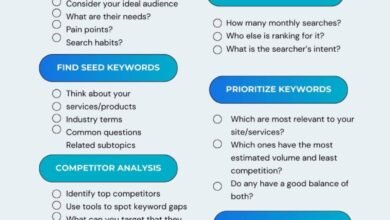
Over the years, I’ve moved away from gut feeling and developed a standardized keyword research process. It takes about 10 minutes per piece of content, but it saves hours of rewriting later. I often use tools to speed this up—sometimes even an AI article generator to help draft the initial structure—but the core research logic is something I always handle manually to ensure accuracy.
The goal is to find terms that balance keyword evaluation metrics with human common sense. Here is the exact workflow I use.
Step 1: write the research question (then extract the nouns and verbs)
Everything starts with a question. If you don’t know what you are answering, you can’t find the keywords. I write down my research question and then highlight the core components.
Example:
Question: “How can small businesses reduce voluntary employee turnover without raising salaries?”
Seed Keywords: “Small business,” “employee turnover,” “voluntary turnover,” “retention strategies,” “non-monetary incentives.”
Step 2: build a seed list (synonyms, acronyms, and ‘same thing different words’)
Different industries use different dialects. In the US, we might say “trucking logistics,” while elsewhere it might be “freight transport.” I spend five minutes expanding my list with keyword synonyms and industry terminology.
Where I look for variations:
- Google Autosuggest: Type your main keyword and see what completes the sentence.
- Competitor Headings: What do the top 3 ranking articles call it?
- Glossaries: Industry association definition pages are gold mines for acronyms.
Step 3: expand and qualify keywords (intent, relevance, and difficulty)
Now I have a messy list. I need to filter it. I look at keyword intent (what does the user want?) and feasibility. If a keyword has massive search volume but the top results are government homepages and Wikipedia, I skip it—the keyword difficulty is too high for a standard blog post. I prioritize keywords where the intent matches my content (informational vs. transactional) and where I can realisticly compete.
Step 4: map keywords to structure (title, headings, abstract/summary, and metadata)
This is where on-page SEO best practices come in. I don’t stuff keywords; I place them where they aid navigation.
- Title/H1: Primary keyword goes here.
- Introduction: Mention the primary keyword and the main problem it solves.
- H2s: Use secondary keywords and H1 and H2 keywords variations.
- Meta Description: Write for the click, using the keyword naturally.
Don’t: Force a keyword where it breaks the grammar. If it sounds robotic, your reader will bounce.
Step 5: validate with real searches (and iterate based on what I find)
Before I finalize anything, I perform SERP validation. I actually search the terms. If I search “turnover analysis” and get recipes for apple turnovers, I know my keyword is ambiguous. I iterate until the results reflect the business context I’m writing about. I keep a simple log of this in a spreadsheet so I can track my keyword iteration logic.
My keyword workflow in 10 minutes (Checklist):
- Write the core question.
- Extract 3-5 seed nouns/verbs.
- Check synonyms (Google suggested search).
- Validate intent (do the results match my topic?).
- Map primary keyword to H1 and URL.
- Map secondary keywords to H2s.
Simple Keyword Brief Template:
Primary Term: [Insert Main Keyword]
Target Audience: [e.g., HR Managers in Tech]
User Intent: [e.g., Informational / Problem Solving]
Must-Include Entities: [e.g., Retention, Exit Interview, Benefits]
Exclusions: [e.g., exclude “involuntary firing”]
Standardized keyword frameworks: how I keep research consistent across teams and time

If you work alone, you can keep keywords in your head. If you work in a team, that is a recipe for disaster. I’ve seen teams where one person tags content as “customer support” and another tags it “client success,” effectively breaking the internal search.
This is where a standardized keyword framework—essentially a controlled vocabulary—saves the day. By agreeing on a standard set of terms, you ensure consistent bibliometric analysis and reliable retrieval.
| Preferred Term | Synonyms (Searchable) | Exclusions | Category | Notes |
|---|---|---|---|---|
| Customer Churn | Attrition, Turnover, Cancellation | Employee Turnover | Metrics | Use for SaaS subscription loss only. |
The minimum viable framework (MVF) I recommend for beginners
You don’t need complex enterprise software to start. Here is my Minimum Viable Framework for keyword standardization:
- Preferred Keyword: The one term everyone must use in titles.
- Synonyms: Words that can appear in text but not as the primary tag.
- Exclusions: Words that confuse the meaning (what this is not).
- Category/Tag: The broad bucket (e.g., “Sales,” “Engineering”).
- Definition: A one-sentence explanation to prevent drift.
AI and NLP keyword extraction: what’s improved (and what I still double-check)

The rise of AI has changed the game. Tools like KeyBERT and Large Language Models (LLMs) have moved us beyond simple frequency counts (TF-IDF) to semantic search. AI can now understand that “automobile” and “car” are the same thing, which improves AI keyword extraction immensely.
Recent trends show AI search tool usage in the US nearly doubled from 14% to 29.2% between 2024 and 2025. This means our keywords need to answer questions, not just match strings. However, while AI is powerful, I treat it as a “drafting assistant,” not the final authority.
| Method | Best For | Limitations |
|---|---|---|
| TF-IDF | Simple frequency analysis. | Misses context; struggles with synonyms. |
| KeyBERT | NLP keyword extraction based on meaning. | Slower than simple stats; requires more compute. |
| LLMs (e.g., Llama 2) | Deep contextual understanding. | Can hallucinate relationships; high resource cost. |
A quick evaluation method: would a real person search this phrase?
AI often suggests technically correct keywords that no human would actually type. For example, an AI might suggest “utilization of retention mechanisms.” I always ask myself: would a stressed manager type this into Google at 4 PM? If not, I reject it. I look for user-perceived relevance—language that mirrors the user’s reality, not the textbook definition.
How businesses use keyword research strategically (SEO, content planning, and competitive gaps)
In a business context, keywords are the connection point between your product and the market’s demand. I use business keyword research to identify high-value opportunities where competitors are weak. This involves looking for competitive gap analysis opportunities—topics your competitors haven’t covered well.
I rely on a mix of tools to streamline this. For instance, I might use an SEO content generator to quickly outline topics based on these gaps, but I always manage the strategy myself.
My Starter Playbook for Business Keywords:
- Identify the core problems your product solves.
- Find the keywords associated with those problems (not just your solution).
- Check the “People Also Ask” boxes for long-tail questions.
- Group these keywords into topic clusters to build topical authority.
- Track performance monthly, not daily.
Using an AI SEO tool can help identify these clusters faster, but the human eye is needed to prioritize which clusters matter most for revenue.
| Metric | What it tells me | How I act on it |
|---|---|---|
| CTR (Click-Through Rate) | Is my title compelling? | Rewrite title/meta description if low. |
| Rankings | Is my content relevant? | Update content depth if rankings drop. |
| Conversions | Is the traffic valuable? | Optimize CTAs if traffic is high but sales are low. |
Ultimately, modern content intelligence—like the approach used by an AI content writer designed for strategy—helps operationalize this by ensuring every piece of content targets a verified intent from day one.
My simple editorial planning loop (research → publish → measure → refine)
I don’t overcomplicate my editorial calendar. I run a simple monthly loop: I pick a topic cluster, select the primary and supporting terms, publish the content, and then wait 30 days. If a page stagnates, I revisit the keywords. Did I miss the intent? Is the keyword too competitive? This cycle of content optimization is far more effective than trying to be perfect on the first try.
Common keyword mistakes I see (and how I fix them)

I’ve made every mistake in the book. Early in my career, I was guilty of keyword stuffing—shoving the phrase into every sentence until it was unreadable. Here are the most common keyword mistakes I see now, and how to fix them.
- Mistake: Vague Keywords.
Why: Fear of being too specific.
Fix: Add a modifier (e.g., change “CRM” to “CRM for real estate agents”). - Mistake: Search Intent Mismatch.
Why: Ignoring the SERP.
Fix: Google the term. If you see products and you wrote a guide, you missed the intent. - Mistake: Ignoring Synonyms.
Why: Obsessing over one exact phrase.
Fix: Use natural language variations throughout the body text. - Mistake: Set-it-and-forget-it.
Why: Thinking SEO is a one-time task.
Fix: Update keywords annually as language evolves.
Mistake-to-fix checklist (copy/paste friendly)
- Is the primary keyword in the Title and H1?
- Does the content match the search intent (Info vs. Transactional)?
- Have I included at least 2-3 synonyms naturally?
- Is the URL clean and keyword-rich?
- Did I avoid stuffing (is it readable aloud)?
- Did I check the “People Also Ask” for sub-headings?
- Is the meta description enticing?
- Have I linked to this page from other relevant pages?
Conclusion: what I’d do next + FAQs about the importance of keywords in research
Keywords are the bridge between your hard work and the audience that needs it. By moving from a guessing game to a structured framework, you ensure your research isn’t just written, but read.
Recap:
- Keywords are critical for indexing, retrieval, and discovery in both academic and business contexts.
- A standardized workflow (Research → Expand → Validate → Map) prevents wasted time and irrelevant results.
- Balancing AI extraction with human validation ensures you match user intent, not just algorithm patterns.
Your Next Actions:
- Write down your current research question and extract 3 seed keywords today.
- Run those keywords through Google to check the “real world” intent.
- Create a “Minimum Viable Framework” spreadsheet for your team’s core terminology.
- Update one old article or paper with better long-tail keywords.
FAQ: Why are keywords essential in research?
Keywords are essential because they act as the primary retrieval mechanism for databases and search engines. Without effective keywords, even high-quality research becomes “invisible” because indexing systems cannot categorize it correctly, leading to poor discoverability and lower citation potential.
FAQ: How do AI tools influence keyword extraction?
AI tools like KeyBERT improve extraction by analyzing the semantic meaning and context of the text, rather than just counting word frequency. However, while they are efficient, I always double-check their output to ensure the selected terms match the specific domain terminology and user intent that a machine might miss.
FAQ: Why use a standardized keyword framework in research?
A standardized framework ensures consistency, especially across teams or long-term projects. For example, if one researcher uses “subscriber churn” and another uses “customer attrition,” data analysis becomes fragmented. A framework unifies these terms, making internal knowledge bases reliable and improving cross-study analysis.