How to get AI to cite my website: The Citation Formula for AI Summaries

What I’m seeing in AI Overviews lately is a fascinating—and somewhat ruthless—shift in how value is assigned. I’ve noticed pages that rank #1 organically sometimes get completely ignored by the AI summary box, while a #4 or #5 result gets the citation simply because it answered the question better. The game isn’t just about ranking anymore; it’s about being the source.
If you are a business owner or marketing lead in the US, you are likely feeling the anxiety of “zero-click” searches. You want to reclaim that visibility as proof of authority. The good news is that getting AI to cite your website isn’t magic, and it doesn’t require a massive engineering team. It requires a specific type of editorial structure and technical signaling.
I treat this as a probability game, not a guaranteed hack. Below is the “Citation Formula”—a repeatable framework I use to restructure content so it becomes machine-readable, factually dense, and irresistible to Large Language Models (LLMs) looking for answers.
What you’ll walk away with
- A 10-point scorecard to audit your existing pages for “citation readiness.”
- A copy-paste BLUF template to fix your content structure immediately.
- A realistic strategy for creating original data (citation magnets) without a research budget.
- A technical checklist including schema targets and the emerging
llms.txtstandard. - A measurement plan to track your progress over the next 30 days.
Quick answer: what it takes to earn AI citations (in plain English)

If you are short on time and need to report back to your team, here is the bottom line. AI models are looking for confident, structured data to substantiate their answers. They don’t want fluff; they want facts.
- High Extractability: The answer is stated directly in the first 2–3 sentences (BLUF format).
- Information Gain: The page contains unique data or metrics not found elsewhere.
- Freshness: The content has been updated recently (AI biases heavily toward new info).
- Authority Signals: Clear author bylines and “About Us” credibility markers.
- Technical Clarity: Schema markup helps the bot understand exactly what the content is.
To understand the urgency here, consider the “recency bias” of these systems. Industry data suggests that 85% of AI Overview citations come from content published within the last two years, with a staggering 44% coming from content published in 2025 alone . Verify these specific numbers with the latest industry report before publishing, but in my experience, the trend is undeniable: AI craves the new.
Why AI doesn’t always cite my website when summarizing content
When I audit a site that isn’t getting cited, I usually find one of two issues. First, the content is buried. If the AI has to read 800 words of backstory to find the return policy, it will skip you for a competitor who put it in a bulleted list. Second, the content is generic. If your article looks exactly like the top 10 search results, the AI has no reason to cite you specifically—it might just cite the biggest brand, or rely on its internal training data.
How AI tools decide what to cite (and when they cite at all)

It is important to manage expectations: you can optimize perfectly and still not get cited every time. We are optimizing for probability, not certainty.
Here is how the mechanism generally works. When a user asks a question with informational intent (which triggers almost all AI Overviews), the AI engine—whether it’s Google’s Gemini, ChatGPT with browsing, or Perplexity—performs a retrieval step (RAG). It looks for live web sources to ground its answer because its training data has a cut-off date.
It selects sources based on a combination of traditional authority (backlinks/brand) and specific “extraction” signals. It effectively asks: “Which page answers this specific query most directly and credibly?”
| Signal | What the AI Needs | How You Provide It |
|---|---|---|
| Relevance | A direct answer to the user’s prompt. | Put the answer in the first paragraph (BLUF). |
| Freshness | Current data, not outdated training data. | Update timestamps and cite recent events/years. |
| Authority | Reason to trust this specific source. | Author bios, citations of sources, clear methodology. |
| Extractability | Content that is easy to parse programmatically. | Lists, tables, summary boxes, and proper H2s. |
| Uniqueness | New information (Information Gain). | Proprietary data, surveys, or unique expert takes. |
Citations vs rankings: what changes (and what doesn’t)
Think of it this way: Rankings get you found; citations get you quoted. Traditional SEO (keywords, backlinks, technical health) is still the table stakes—you generally need to be in the top 10–20 results for the AI to even consider you as a candidate. However, citation optimization focuses heavily on structure. You can be ranked #1, but if your content is a wall of text, the AI might cite the #3 result that uses a clean data table.
The recency bias: why updates matter
I cannot stress this enough: old content is invisible to the “news” side of AI. With 44% of citations reportedly coming from content published in the current year , you need a refresh cadence. For my clients, I recommend a quarterly review of their top 10 traffic-driving pages. Don’t just change the date; add a “What changed in [Current Year]” section. This signals to the model that the content is current and valid.
The Citation Formula: a practical framework I use to increase the odds AI cites my site

When I’m faced with a drop in traffic or a need to build authority, I don’t just guess. I use a framework I call “The Citation Formula.” It consists of five parts: Extractable Answers + Credible Signals + Freshness + Unique Data + Technical Machine-Readability.
If you apply this formula, you move your content from “readable by humans” to “preferred by machines.” In a real business workflow, I prioritize this based on existing performance. If time is tight, I start with pages already ranking in the top 10—because they are closest to being citation-ready. Scaling this across hundreds of pages can be daunting, which is where using an AI SEO tool to help audit and draft structured updates becomes a workflow lifesaver.
The 10-point page scorecard (table)
Use this scorecard to audit a page. A score below 5 means you are unlikely to be cited. Aim for an 8+.
| Category | Criteria (Score 0, 1, or 2) | What to look for |
|---|---|---|
| 1. Answer Location | 0=Buried, 2=First 100 words | Is the direct answer visible above the fold? |
| 2. Formatting | 0=Walls of text, 2=Lists/Tables | Do you use summary boxes or key takeaway bullets? |
| 3. Uniqueness | 0=Generic, 2=Unique Data/Quote | Do you have a stat or quote no one else has? |
| 4. Freshness | 0=Old/Undated, 2=Updated <6mo | Is there a “Last Updated” date and recent info? |
| 5. Schema | 0=None, 2=FAQ/Article Schema | Does the page pass the Rich Results Test? |
Where this fits in a real workflow
You don’t need to stop everything to do this. I recommend a “Friday Fix” approach. Pick 3 high-priority pages each week. Score them. Apply one improvement per component (e.g., add a summary box or a data table). Monitor them for two weeks. It is boring work, but it compounds.
Step 1 — Make content extractable: BLUF, summary boxes, and scannable sections

When I’m optimizing a page for citations, I start by editing the writing style. We need to move from “marketing fluff” to “Bottom Line Up Front” (BLUF). AI models are essentially predicting the next best token; if you lead with a clear, concise definition or answer, you make the model’s job easy.
For example, I once saw a client’s refund policy page that started with three paragraphs about “how much we value our customers.” We moved the refund timeline (30 days) and condition (unworn) to a bolded box at the very top. Within two weeks, that snippet was being pulled into search summaries.
Research suggests that readability improvements can boost visibility gains by 15%–30% . If you are rewriting hundreds of articles, maintaining this discipline is hard. This is where an AI article generator can be helpful—not to write the final piece, but to generate consistent BLUF drafts that you can edit for accuracy.
BLUF template (copy/paste)
If you are short on time, copy this structure into your CMS:
[H2] Quick Answer: [Your Main Keyword Question]
The Answer: [Direct 2-3 sentence answer. No fluff. Use bolding for key terms.]
Key Takeaways:
- [Critical Point 1]
- [Critical Point 2]
- [Critical Point 3]
Who this is for: [Specific Audience]
Formatting rules AI tends to ‘like’ (because it’s easy to parse)
- Short Paragraphs: Keep them to 2–3 sentences max. It helps the AI isolate distinct ideas.
- Logical Headings: Use H2s for main topics and H3s for sub-topics. Never skip levels (e.g., H2 to H4).
- Definitions First: If you introduce a term, define it in the immediate next sentence.
- Consistent Terminology: Don’t switch between “client,” “customer,” and “user” if you mean the same thing. It confuses the context window.
Add FAQs without bloating the page
FAQs are citation goldmines because they mimic the Q&A format of a user search. However, please don’t stuff them with keywords. Use questions real people ask (check People Also Ask). If you can’t answer the question in 2–3 sentences, it’s probably a separate article, not an FAQ item.
Step 2 — Become “citation-worthy” with original data (your citation magnet)

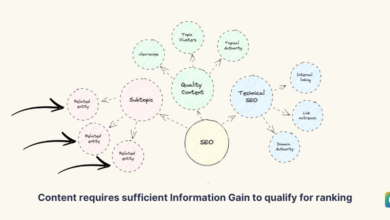
Here is the hard truth: if your content is just a rewrite of the top 3 results, the AI has no incentive to cite you. It needs “Information Gain”—something new to add to its knowledge base.
You don’t need a research department to do this. I often advise small businesses to look at their own internal data. Do you have sales logs? Support tickets? Project timelines? Aggregating this into a simple benchmark creates a “citation magnet.” For example, a plumber could publish “Average water heater lifespan in [City] based on 500 replacements: 8.5 years.” That is unique data that AI loves to reference.
What makes content citation-worthy to AI tools
It comes down to specificity. Generic statements like “software implementation takes time” are ignored. Specific statements like “Our 2024 client data shows implementation averages 4.2 weeks” are cited.
Table: citation magnet ideas for business websites
| Data Asset Idea | Effort Level | Trust Boost | How to Present It |
|---|---|---|---|
| Internal Benchmarks | Low | High | Simple bar chart + “Key Findings” list. |
| Mini-Survey | Medium | High | Ask 50 customers 3 questions via email. |
| Cost/Price Ranges | Low | Medium | Table with Low, Average, High columns. |
| Expert Consensus | Medium | Medium | Quote 3 industry experts on one topic. |
How to present data so it gets cited (not ignored)
Always include a methodology note. It sounds academic, but it builds trust. A simple line like “Data based on 150 customer projects executed between Jan 2024 and Dec 2024” tells the AI (and the human reader) that this isn’t made up. Also, label your charts clearly. AI vision models can read charts, but clear HTML tables are still the safest bet for extraction.
Step 3 — Technical and trust signals: schema markup, crawlability, and llms.txt

You can have the best data in the world, but if the bot can’t parse it, you lose. This is where we get technical, but I promise to keep it practical. We need to ensure your content is machine-readable.
How schema markup helps with AI citations
Schema markup is code that tells search engines what your content is, not just what it says. For AI citations, FAQ Schema is incredibly powerful because it explicitly defines a Question and an Answer. Article and Author schema help establish the credibility of the source. If you aren’t using these, you are forcing the AI to guess the structure of your page. Don’t make it guess.
llms.txt: what it is, when to use it, and a simple example
There is an emerging standard called llms.txt. Think of it as a robots.txt file but specifically for AI agents. It tells them, “Here are the most important files on my site to read to understand who we are.”
It is currently optional and more common in developer-centric circles, but I view it as cheap future-proofing. You place it at the root of your domain (e.g., yourdomain.com/llms.txt).
Simple Example:
# Site Identity
- Title: My Business Name
- Description: Expert guide to [Topic]

# Key Resources
- https://yourdomain.com/pricing
- https://yourdomain.com/core-methodology
- https://yourdomain.com/about-us
Technical readiness checklist (beginner-friendly)
- Crawlability: Is the page indexable and not blocked by robots.txt?
- HTML Visibility: Is the main content visible in the HTML source (not hidden behind a “Read More” button or heavy JavaScript)?
- Internal Linking: Do other authoritative pages on your site link to this page?
- Author Bio: Is there a real person associated with the content?
- Schema Validation: Have you run the URL through Google’s Rich Results Test?
Troubleshooting: common mistakes, FAQs, and next steps to earn more AI citations

If you have implemented the changes above and still aren’t seeing results, don’t panic. These systems are volatile. Here is how I debug issues when a client’s page isn’t getting picked up.
Common mistakes (and the fix)
- Burying the lede: The answer is in paragraph 4. Fix: Move it to paragraph 1.
- Vague dating: No “Last Updated” date. Fix: Add a visible date and a note on what changed.
- Weak Authority: posted by “Admin.” Fix: Assign a specific author with a bio.
- No Structure: It’s a 2,000-word wall of text. Fix: Break it with H2s, H3s, and lists.
- Blocked Resources: Your firewall is blocking AI bots. Fix: check your server logs/settings.
FAQs
Why doesn’t AI always cite my website when summarizing content?
It likely perceives another source as more authoritative, more recent, or easier to extract information from. It may also be relying on its internal training data rather than a live web search if the query doesn’t demand real-time info.
How should I structure content to maximize AI citation chances?
Use the BLUF (Bottom Line Up Front) method. Place a direct, 40–60 word answer immediately after the H1 or H2. Follow it with a bulleted summary of key takeaways and an FAQ section at the bottom.
What makes content “citation-worthy” to AI tools?
Information Gain. This means specific stats, original benchmarks, or unique expert quotes that cannot be found on other websites. For example, “costs range from $500-$1000” is generic; “our average project cost in 2024 was $850” is citation-worthy.
How does schema markup help with AI citations?
It disambiguates your content. FAQ schema specifically pairs questions with answers in a format machines understand perfectly, increasing the probability that the AI extracts that specific snippet.
What is llms.txt and should I use it?
It is a text file that guides AI bots to your most important content. While not mandatory yet, it is a low-effort way to help AI agents navigate your site efficiently. I recommend adding a simple one if you have access to your server root.
Conclusion: my 30-minute plan for this week
This can feel like a lot, but you don’t need to overhaul your entire site overnight. If I only had one afternoon to improve my AI visibility, here is exactly what I would do:
- Pick one high-traffic page that hasn’t been updated in 6 months.
- Add a “Quick Answer” box at the top with a clear definition.
- Insert one data table (even if it’s just comparing features or pricing).
Then, check back in 30 days using Google Search Console to see if impressions for informational queries have ticked up. It’s a game of incremental improvements, but the businesses that structure their content for machines today will be the authorities of tomorrow.