Introduction: The Road to #1 (and who this SEO campaign plan template is for)

I used to run SEO campaigns off sticky notes and “urgent” Slack messages. It worked—until it didn’t. The breaking point wasn’t a Google update; it was a quarterly review where I couldn’t explain why traffic was up but leads were flat. I realized I was executing random tactics, not a campaign.
If you are an intermediate marketer or an “accidental SEO lead” managing a small team, you probably feel this chaos. You have keywords and a developer who is too busy, but no cohesive roadmap.
This article provides a downloadable-style SEO campaign plan template. It is not a theoretical whitepaper. It is a structured, 90-day framework designed for the US market that moves you from “random acts of content” to a predictable system. We will cover baseline audits, intent-first keyword mapping, technical essentials, and the quarterly reporting cadence that keeps stakeholders happy.
What an SEO campaign plan template is (and what it isn’t)

An SEO campaign plan is a project management document that translates high-level strategy into weekly tasks. It bridges the gap between “we need more traffic” and “publish this article on Tuesday.”
Most beginners confuse an audit checklist with a strategy—totally normal, but dangerous. A checklist tells you what is broken; a campaign plan tells you how (and when) you will grow.
What this template is:
- A quarterly roadmap (Build → Execute → Measure).
- A prioritization tool to manage limited resources.
- A bridge between content, technical SEO, and business goals.
What this template is NOT:
- A magic list of “secret” hacks.
- A one-time document you create and never look at again.
- Just a keyword list (keywords are ingredients, not the meal).
Quick answer (for beginners)
An SEO campaign plan template is a structured workflow that organizes your strategy into actionable stages: Goal Setting → Audit → Research → Roadmap Creation → Execution → Measurement → Iteration. It ensures every task—from technical fixes to content creation—directly supports a specific business outcome within a defined timeline.
Why search intent beats “just keywords” in 2026
In 2026, keywords are just proxies for user problems. If you rank for a term but fail to solve the problem, users bounce, and Google notices. Research suggests that pages fully aligned with search intent rank approximately 30% higher than those that merely target the keyword text .
For example, a user searching “best CRM for small business” wants a comparison list (Commercial Investigation). If you serve them a sales page for your specific CRM (Transactional), you have failed the intent check. The user leaves, and your rankings tank. My template forces you to map this intent before you write a single word.
Step 0: Align SEO with business goals, KPIs, and constraints (before I touch keywords)

Before opening a keyword tool, I sit down with the business stakeholders (or myself) and define what winning looks like. If you skip this, you risk spending three months climbing the wrong ladder.
I don’t chase vanity keyword counts in month one; I chase non-branded clicks to the pages that sell. This requires understanding your constraints. If you can’t get developer time for six weeks, don’t build a plan that relies on a massive site migration in week two.
We also need to leverage the right tools. While a sophisticated SEO content generator can speed up your drafting and research process, the initial strategy still requires human judgment to align with specific business revenue targets.
Choose 1–3 quarterly goals (and write them as hypotheses)
I frame goals as scientific hypotheses. This keeps the emotion out of it when things need adjustment. Pick 1–3 high-impact goals per quarter.
Example Hypothesis (SaaS):
“If we update our top 5 ‘alternative’ comparison pages with 2026 pricing data and better comparison tables, we will increase organic demo signups by 15%.”
Why this works: It targets a specific metric (demo signups) via a specific action, making success easy to measure.
KPI table: SEO metrics that actually map to business outcomes
Here is the KPI framework I use to keep my reporting focused on revenue, not just rankings.
| KPI | Definition | Tool Source | Reporting Cadence |
|---|---|---|---|
| Non-Branded Clicks | Traffic from people who didn’t already know your name. | Google Search Console | Weekly |
| Organic Conversions | Leads, sales, or signups directly from search traffic. | GA4 / CRM | Monthly |
| Assisted Conversions | Users who found you via SEO but converted later (e.g., via email). | GA4 | Quarterly |
| Keyword Visibility | Rankings for your “money” terms (top 3 positions). | SEMrush / Ahrefs | Weekly |
My step-by-step SEO campaign plan template: audit → strategy → roadmap → launch

This is the core of the work. When I build a campaign, I treat it like software development: sprints, owners, and deliverables. Integrating all these components into a unified roadmap can drive significant organic growth—often citing a 25% traffic increase in a single quarter for teams moving from ad-hoc work to structured plans .
If you are looking to scale content production during the execution phase, using a Bulk article generator can help maintain consistency across your cluster, but only after this strategic foundation is set.
Below is the structure I use for my campaign board (paste this columns into Asana, Monday, or Sheets):
| Phase | Task | Owner | Effort (1-5) | Impact (1-5) | Due Date | Status |
|---|---|---|---|---|---|---|
| Audit | Run crawler & fix broken links | Tech Lead | 2 | 3 | Week 1 | Done |
| Strategy | Map intent for “HR Software” cluster | SEO Lead | 4 | 5 | Week 2 | In Progress |
| Build | Draft 4 support articles for cluster | Content Writer | 5 | 4 | Week 3-4 | Pending |
Phase 1 — Baseline audits (technical, content, and authority)
You cannot build on a shaky foundation. I keep the baseline audit focused on “dealbreakers” rather than perfection.
- Technical: Check indexing status in GSC. Are your money pages actually on Google? (You’d be surprised how often a
noindextag is left on a critical page). - Content: Identify thin content and cannibalization. Do you have three different pages trying to rank for the same keyword?
- Authority: Sanity check your backlink profile. Are there toxic links? Do you have enough authority to compete for high-difficulty terms?
Phase 2 — Prioritize work by impact × effort (and revenue potential)
The hardest part of this job is saying “no.” You cannot do everything. I use a simple Impact vs. Effort scoring model.
- High Impact / Low Effort: Do these immediately (e.g., updating meta titles on high-impression pages).
- High Impact / High Effort: Schedule these as major projects (e.g., creating a new pillar page).
- Low Impact / Low Effort: Fillers.
- Low Impact / High Effort: Ignore these.
Hard Truth: If a task doesn’t have a clear path to revenue or traffic, it gets cut from the roadmap.
Phase 3 — Build the campaign roadmap (owners, dependencies, buffers)
I translate my priorities into a calendar. The key here is identifying dependencies. I can’t publish the schema if the dev team hasn’t approved the plugin. I can’t internal link the cluster until the pillar page is live.
Pro Tip: Always build a 20% time buffer. If you think writing the briefs will take one week, schedule it for 1.5 weeks. Life happens.
Phase 4 — Execute and publish consistently (without losing quality)
This is where plans go to die if you aren’t disciplined. Execution involves:
- Content Ops: Brief creation, drafting, editing, and staging.
- Tech Sprints: Developers implementing schema or speed fixes.
- QA: Never hit publish without a human review. Even with automation tools, I always verify internal links and factual accuracy manually.
Build a content plan that matches search intent (keywords, clusters, and briefs)

A list of keywords is not a plan. A plan is a map of how those keywords fit together. I organize everything into Topic Clusters: a central “Pillar” page that covers the broad topic, surrounded by “Spoke” pages that go deep into subtopics.
Studies show that topic clusters can yield an average traffic increase of ~22% by signaling authority to Google . When I’m building these out, I might use an AI article generator to help structure the drafts, but the intent mapping comes strictly from my brain.
Intent mapping: informational vs commercial vs transactional (with examples)
Every keyword on your roadmap needs an assigned intent label. This dictates the page format.
- Informational (Know): User wants to learn. Format: How-to guides, definitions.
Example: “What is SEO?” - Commercial (Investigate): User is comparing options. Format: Best-of lists, comparison tables.
Example: “Best SEO tools for small business” - Transactional (Do): User is ready to buy. Format: Product page, pricing page, demo signup.
Example: “Buy SEO software”
Content cluster template (pillar + spokes) + internal linking rules
Here is my golden rule for internal linking: The Pillar supports the Spokes, and the Spokes support the Pillar.
Imagine a bicycle wheel. The Pillar is the hub. The Spokes are the tires. The internal links are the metal spokes connecting them.
- Pillar Page: “Ultimate Guide to Email Marketing” (Links out to all sub-articles).
- Spoke Page 1: “Email Subject Line Best Practices” (Links back to Pillar + Spoke 2).
- Spoke Page 2: “Best Time to Send Emails” (Links back to Pillar + Spoke 1).
Technical SEO checklist for 2026: Core Web Vitals, crawlability, and schema for AI visibility

In 2026, you cannot ignore technical health. It’s the admission ticket to the game. If your site is slow or confusing to bots, your great content won’t rank.
Data indicates that 72% of top-performing sites achieved LCP (Largest Contentful Paint) under 2 seconds following recent core updates . Furthermore, with AI Overviews appearing in roughly 20% of searches, having structured data is no longer optional—it’s how you get cited by the AI .
| Item | Why it matters | Target Threshold | Who Owns It |
|---|---|---|---|
| LCP (Speed) | User experience & ranking factor | < 2.5 seconds | Developer |
| Mobile Usability | Mobile-first indexing is the standard | 0 Errors in GSC | Developer / Designer |
| FAQ Schema | Capture rich snippets & AI summary real estate | Valid JSON-LD | SEO / Content Editor |
| Index Bloat | Prevents wasting crawl budget on junk | Review Monthly | SEO Lead |
Core Web Vitals priorities (what I fix first)
If you have limited resources, prioritize LCP (Largest Contentful Paint). It is the most noticeable speed metric for users—basically, how fast does the main content load? Fix image compression and server response times first. I often tell clients: “Faster load times equal better conversion rates. It’s not just for Google.”
Schema for visibility: FAQ/HowTo + tracking impact
Schema is like handing Google a business card that says exactly who you are. I include schema requirements directly in my content briefs. A simple checkbox saying “FAQ Schema Added + Tested” prevents us from missing out on rich results.
Measure results and iterate quarterly (Build → Execute → Measure → Adapt)
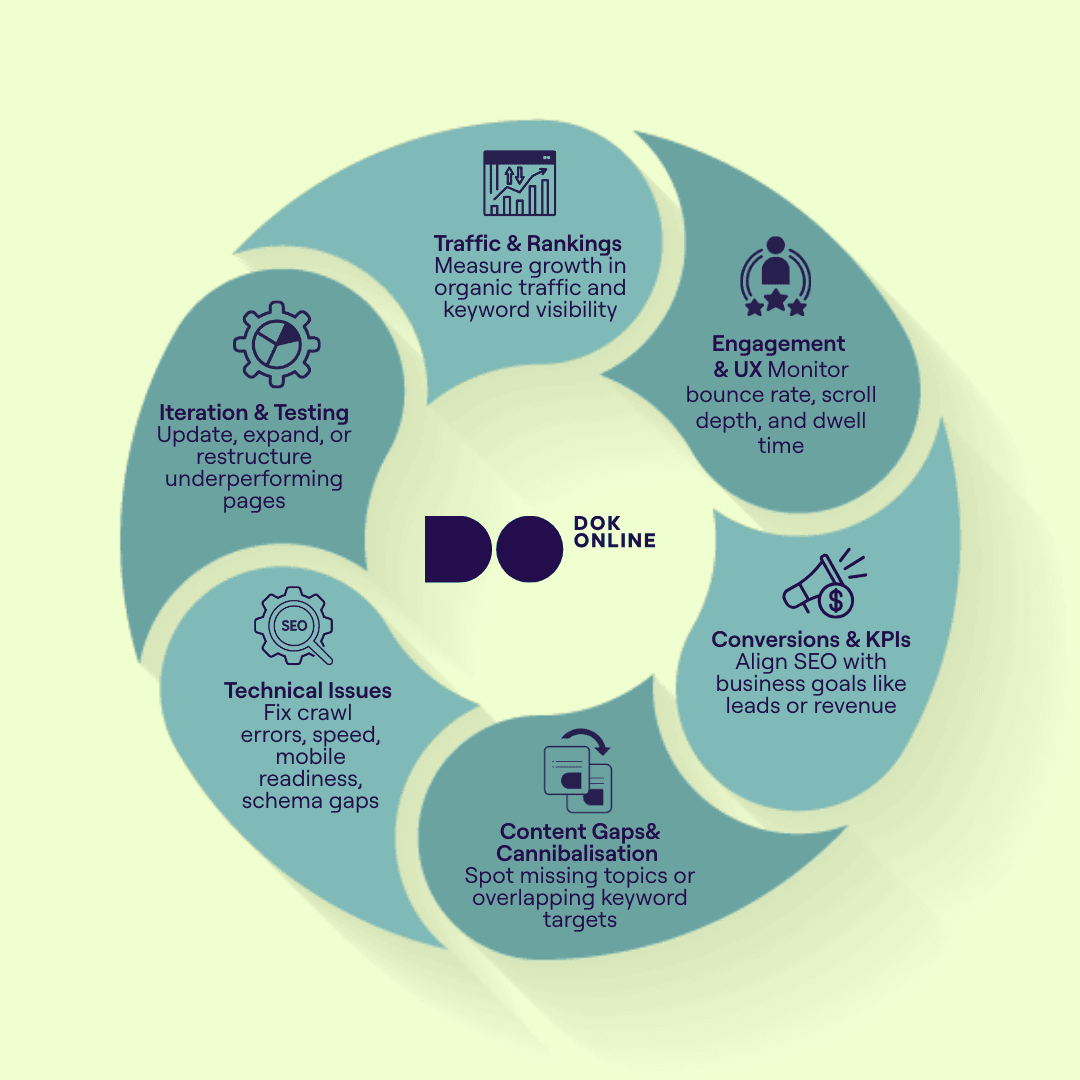
The campaign doesn’t end when you hit publish. That’s when the data starts coming in. I run my SEO on a quarterly cycle: Build → Execute → Measure → Adapt.
If results are flat, I don’t panic. I investigate. Did we miss the search intent? Is the page technically broken? Are we lacking internal links? I then use these learnings to form the hypothesis for the next quarter.
What I track weekly vs monthly vs quarterly
- Weekly: Technical errors (GSC), Impressions, Position changes for top 20 keywords. (Don’t panic over daily fluctuations).
- Monthly: Organic traffic growth, Lead/Conversion volume, Blog post performance.
- Quarterly: Full strategy review. Revenue impact. Competitor analysis. Roadmap reset.
Common SEO campaign planning mistakes beginners make (and how I fix them)

I have made every mistake in the book. Here is how you can avoid them.
- Mistake: Creating content without a brief.
Why it hurts: You miss intent and keywords. The writer guesses.
Fix: Never assign an article without an outline covering H2s, keywords, and user intent. - Mistake: Ignoring internal links.
Why it hurts: You create “orphan pages” that Google can’t find or value.
Fix: Add an “Internal Linking” pass to your pre-publish checklist. - Mistake: Measuring only rankings.
Why it hurts: Rankings don’t pay the bills. Revenue does.
Fix: Align SEO goals with CRO metrics (signups/sales) from Day 1. - Mistake: “Set it and forget it” planning.
Why it hurts: The market changes. Google changes.
Fix: Review your roadmap monthly and be willing to kill projects that aren’t working.
Mistake-to-fix checklist (copy/paste)
- Audit performed? [ ]
- Intent mapped for every keyword? [ ]
- Schema requirements in briefs? [ ]
- KPIs defined (not just traffic)? [ ]
- Owners assigned to every task? [ ]
Conclusion: My 90-day SEO campaign plan template recap + FAQs
SEO isn’t magic; it’s discipline. If you take anything away from this, let it be these three things:
- Structure beats chaos: Use the quarterly roadmap to stay focused.
- Intent beats volume: Rank for what drives revenue, not just clicks.
- Technical is foundational: Don’t build a mansion on a swamp.
Next Actions:
- Copy the roadmap table into your project tool today.
- Run your baseline audit this week.
- Pick your top 3 goals for the next 90 days.
FAQ: Why focus on search intent and not just keywords?
Because Google’s algorithms (and your users) care about solving problems, not matching strings of text. If you match intent, you satisfy the user, leading to better engagement signals and higher conversion rates. Mismatching intent is the fastest way to waste a content budget.
FAQ: How does content clustering help SEO?
Clustering positions you as an expert on a topic, not just a keyword. By linking a high-level pillar page to specific spoke pages, you distribute authority across your site. This helps you rank for a broader range of terms and builds “Topical Authority,” which is critical in 2026.
FAQ: Do technical optimizations still matter?
Absolutely. While content is king, technical SEO is the castle walls. Core Web Vitals (speed) and Schema (vocabulary) are essential. For a small team, start with the basics: ensure your site loads under 2.5 seconds and that you aren’t blocking Google from indexing your best pages.
FAQ: How can I ensure my SEO plan supports business goals?
Start from the revenue line and work backward. Identify which pages drive sales (product/service pages), and build your SEO strategy to drive traffic there or to informational content that links there. Measure success by conversions, not just impressions.
FAQ: How often should I review and update my campaign plan?
I recommend a full strategy reset every quarter (90 days). This gives your tactics enough time to show results but allows you to pivot before you waste an entire year. Set your next review date on the calendar right now.