Beyond Ranking — what does a full-service SEO agency do in 2026?
I used to judge SEO strictly by rankings. It was a simple metric: if we moved from position 10 to position 3, we were winning. Then I sat in a board meeting where the marketing director showed a graph of rising rankings, and the CEO showed a graph of flat revenue. The silence in that room was deafening.
That disconnect is why the definition of a “full-service SEO agency” has fundamentally changed. In 2026, it is no longer about tricking an algorithm into showing your blue link. It is about engineering brand authority, ensuring technical accessibility for both humans and AI, and creating content that actually answers user questions rather than just filling space.
If you are a founder or a marketing lead hiring your first serious agency, you are likely trying to de-risk a significant investment. You suspect SEO is broader than “keywords + backlinks,” but the proposals you receive are often full of jargon. This article is your plain-English map. I’m going to break down exactly what a modern full-service agency does, the four pillars they must manage, and how to tell the difference between a partner who drives growth and a vendor who just sends reports.
Quick answer: What does a full-service SEO agency do (beyond rankings)?

A full-service SEO agency is a cross-functional partner that handles the entire organic visibility lifecycle. They don’t just “do SEO”; they act as the architects of your brand’s digital presence across search engines and AI discovery platforms. Their goal is to turn search intent into business outcomes.
Here is the deliverables-level breakdown of what they actually do:
- Strategic Roadmapping: Auditing your market position and prioritizing work based on revenue potential, not just search volume.
- Technical Infrastructure: Ensuring search bots (and AI crawlers like GPTBot) can access, render, and understand your site.
- Content Operations: Researching, briefing, and producing “answer assets” that satisfy user intent.
- Authority Building (Off-Page): Earning trust through digital PR, unlinked mentions, and legitimate reviews—building the “Trust Layer.”
- Intelligence & Reporting: Measuring ROI, attribution, and visibility in new channels like AI answers (GEO/AEO).
What it is NOT: If an agency tells you their job is just “writing blog posts” or “building 10 links a month,” they are a service provider, not a full-service agency. Real agencies own the outcome.
The modern full-service SEO agency framework: 4 pillars + a repeatable workflow
The easiest way to evaluate a proposal is to check if it covers the modern framework. If I’m auditing an agency’s process, I look for a cohesive loop: Audit → Roadmap → Implementation → Measurement → Iteration. If they skip the roadmap and go straight to “fixing tags,” they are guessing.
Modern SEO relies on four integrated pillars. If one is missing, the stool falls over. Here is how the approach has shifted from traditional methods:
Traditional SEO vs Modern Full-Service SEO (2026)

| Feature | Traditional SEO (Old School) | Modern Full-Service SEO |
|---|---|---|
| Primary Goal | Rankings for specific keywords | Share of voice & revenue attribution |
| Content Strategy | Volume-based blogging (500 words) | “Answer Assets” & Topic Clusters |
| Technical Focus | Meta tags & basic sitemaps | Core Web Vitals, JS Rendering, Schema |
| AI Strategy | Ignored or feared | Optimized for GEO/AEO (AI Answers) |
Pillar 1 — Technical foundation (make the site accessible, fast, and understandable)

This is the plumbing. It doesn’t matter how beautiful your content is if Google’s crawlers (or ChatGPT’s bots) hit a wall when they try to read it. A full-service agency manages indexing (getting pages stored), rendering (making sure code works), and structured data (translating content into machine-readable language).
Pillar 2 — Answer-asset content (build pages that deserve to rank and get cited)

Modern agencies don’t just target keywords; they build Answer Assets. These are definitive resources—like a proprietary data study, a calculator, or a comprehensive guide—that satisfy a user’s problem so well that other sites (and AI models) cite you as the source. Think of it less like “blogging” and more like building a library.
Pillar 3 — Trust layer (prove authority off-site)

You can say you’re an expert, but do others agree? The Trust Layer is about E-E-A-T (Experience, Expertise, Authoritativeness, and Trustworthiness). It involves digital PR, managing reviews, and ensuring your brand is mentioned in the right industry conversations. It’s the difference between a self-published pamphlet and a peer-reviewed journal.
Pillar 4 — Visibility intelligence (measure what’s changing, including AI search)
We are flying blind without data. A modern agency monitors metrics that actually impact the bottom line: conversion rates, assisted conversions, and Share of Voice in AI answers. They use intelligence to pivot strategy, not just to report on what happened last month.
Pillar 1 in practice: Technical SEO a full-service agency should handle
Technical SEO often scares stakeholders because it sounds like developer territory. But here is the reality: developers build features for users; SEOs ensure those features are compatible with search engines. When I walk a non-technical stakeholder through a site health check, I use the analogy that technical SEO is like maintaining the roads to your store. If the road is blocked, no customers arrive.
Here is the checklist of technical deliverables you should expect:
- Crawlability & Indexation: Managing
robots.txt, fixing broken links (404s), and ensuring sitemaps are accurate. Sitemaps are like a directory, not a guarantee—you have to prove the pages are worth visiting. - Site Architecture: organizing content into logical hierarchies (Topic Clusters) so authority flows from your home page to deep pages.
- Core Web Vitals (CWV): Optimizing loading speed (LCP), interactivity (INP), and visual stability (CLS).
- Schema Markup: Implementing JSON-LD code that helps search engines understand entities (e.g., “This is a Product,” “This is an Event”).
- International SEO: Managing
hreflangtags if you operate in multiple regions.
Crawlability + indexation (what gets discovered and stored)
I’ve seen clients publish hundreds of pages that never drove a single visitor because a “noindex” tag was accidentally left on from the staging environment. A full-service agency monitors Log Files to see exactly where bots are spending their time. If bots are crawling your “Terms of Service” 500 times a day but ignoring your high-margin product pages, that is a technical failure the agency must fix.
Site architecture + internal linking (how authority and context flow)
Think of an e-commerce category tree. If your “Running Shoes” page is buried six clicks deep, Google assumes it’s unimportant. Agencies optimize Internal Linking to pass authority (often called “link juice”) to your most valuable pages, ensuring users and bots can navigate intuitively.
Performance & Core Web Vitals (speed that affects real users)
Speed is a trust signal. Research suggests that bounce rates spike dramatically as load time increases from 1 second to 3 seconds. Agencies work with developers to compress images, defer JavaScript, and clean up code bloat. It’s not just about passing a Google test; it’s about not frustrating your customers.
Structured data & rendering (help search engines and AI understand content)
Schema markup is the translator between your content and the machine. Before schema, a search engine saw text. After schema, it sees structured entities: a price, a rating, an author, a date. This is critical for winning “rich snippets” (the visual boxes in search results) and helps AI models parse your facts correctly.
AI crawler accessibility (future-proofing: GPTBot and beyond)
This is the new frontier. Agencies must now help you decide: do you want AI bots like GPTBot to train on your content? In most cases, if you want to appear in AI-generated answers, the answer is yes. A full-service agency manages these permissions via the robots.txt file to control who gets access to your intellectual property.
Pillar 2 in practice: Content strategy, on-page SEO, and “answer assets”
The days of “write 500 words about X” are over. If you’re publishing at scale, the constraint becomes editorial consistency and depth, not just idea generation. This is where modern agencies leverage tools like the AI article generator to handle the drafting heavy lifting, allowing human strategists to focus on intent and nuance.
Here is what I expect in a professional SEO content brief:
- Primary Keyword & User Intent: Is the user looking to buy (Transactional) or learn (Informational)?
- Secondary Keywords: Semantic variations to include naturally.
- Target Audience: Who is reading this? (e.g., “CTOs,” not “students”).
- Structural Outline: H2s and H3s mapped to the topic.
- Internal Linking Requirements: Specific pages to link to.
- “Answer Asset” Data: What unique data or table will make this page link-worthy?
From keywords to intent: how agencies choose what to publish
I once saw a SaaS company burn budget ranking for “free invoice template” when they sold enterprise accounting software. The traffic was huge, but the conversion rate was zero. They were targeting the wrong intent. A smart agency maps keywords to the buyer’s journey, prioritizing high-intent topics (bottom of the funnel) before chasing vanity traffic.
On-page SEO checklist (titles, metas, headings, schema, internal links)
- Title Tags: Accurate, compelling, and under 60 characters.
- Meta Descriptions: A sales pitch for the click (CTR optimization).
- Header Tags (H1-H6): Logical structure, not just styling.
- URL Structure: Clean, descriptive, and short.
- Image Alt Text: Descriptive text for accessibility and context.
Answer assets: the content that earns citations (including AI answers)
To be the authority, you must provide the source material. Agencies produce Answer Assets—original research, industry benchmarks, or expert frameworks—that others cite. In the age of AI, being the cited source in a ChatGPT answer is the new “Position 1.” A small business might create a “2026 Price Guide for [Service]” to become the definitive local resource.
Pillar 3 in practice: Off-page SEO, authority building, and the trust layer
Off-page SEO is the reputation management of the digital world. It’s risky if done poorly. If an agency guarantees you “50 links a month” for a flat fee, run. That is a link farm, and it’s a ticking time bomb for a Google penalty.
Trust layer signals I look for:
- Digital PR: Earning mentions in news outlets or industry journals.
- Unlinked Mentions: Getting brands to turn a text mention into a link.
- Guest Expertise: Your founders appearing on relevant podcasts or webinars.
- Review Velocity: A steady stream of genuine customer reviews.
- Local Citations: Consistent Name, Address, Phone (NAP) data across directories.
Link earning vs link buying (what a reputable agency will say)
Link Buying is paying a shady vendor to place a link on a site that exists solely to sell links. Google hates this. Link Earning is creating content so valuable that reputable sites link to it voluntarily, or conducting outreach to show relevant publishers why your content adds value to their readers. It takes longer, but the ROI compounds instead of crashing.
Brand mentions, reviews, and reputation (especially for US markets)
For US-based businesses, Google looks heavily at “Entity Signals.” Are you a real business? Do you have a physical presence? Do people talk about you? An agency manages your Google Business Profile and monitors third-party review sites. A practical tip I’ve seen work is automating review requests exactly when the customer is happiest—right after a successful delivery or project completion.
GEO & AEO: How full-service SEO agencies optimize for AI answers (and why it matters)
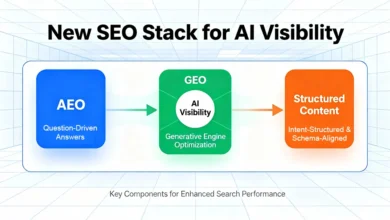
Search is shifting. Since 2025, we’ve seen the rise of Generative Engine Optimization (GEO) and Answer Engine Optimization (AEO). This is optimizing for platforms like ChatGPT, Perplexity, and Google’s AI Overviews.
Unlike traditional SEO, you can’t just “insert keyword here.” AI models look for consensus and authority. An agency’s job is to ensure your brand is part of the training data and is structured clearly enough to be cited.
What are GEO and AEO (in plain English)?
GEO helps your content get found and synthesized by generative AI models. AEO focuses on answering a user’s question so directly that the engine serves your content as the single, definitive answer (like a Featured Snippet on steroids). The goal isn’t just a link; it’s to be the answer.
How agencies create “answer-ready” content blocks
To win here, agencies restructure content. They move the direct answer to the top of the section (the “BLUF” method—Bottom Line Up Front). They use HTML tables and bullet points because bots can parse structured lists easier than dense paragraphs. For example, instead of a 200-word paragraph comparing two products, a modern agency creates a comparison table with clear “Winner” columns.
Measurement & strategic intelligence: how agencies prove SEO is working now

The era of vanity metrics is over. If an agency reports on “Keyword Rankings” but can’t discuss “Pipeline Generated,” they aren’t full-service. Modern measurement requires sophisticated intelligence, often using platforms like Kalema to understand the broader context of visibility beyond simple rank tracking.
SEO metrics that matter (and what they tell me):
| Metric | What it measures | Why it matters |
|---|---|---|
| Organic Revenue / Leads | Business Outcome | The only metric the CFO cares about. |
| Conversion Rate | Traffic Quality | Are we attracting the right people? |
| Assisted Conversions | Customer Journey | Did SEO introduce the customer who bought via Email? |
| Share of Voice | Market Dominance | How visible are we compared to competitors? |
| AI Citation Share | Future Visibility | How often are we cited in AI answers? |
How agencies measure success beyond rankings
Rankings are a leading indicator; revenue is a lagging indicator. A good agency reports on both. They use Multi-Touch Attribution to show that while the organic search blog post didn’t get the immediate sale, it was the first touchpoint that brought the customer into the funnel three months ago.
AI visibility audits & citation monitoring (the new layer of reporting)
Agencies are now conducting “AI Visibility Audits.” They test common industry questions in major LLMs to see if your brand is recommended. If you sell CRM software and ChatGPT recommends your top three competitors but not you, that’s a branding gap that requires a strategic content push to fix.
How I’d choose (or audit) a full-service SEO agency: checklist, red flags, FAQs, and next steps
Hiring an agency is a marriage, not a transaction. You need compatibility. If you are operating a lean team and need to scale content production internally before hiring an agency, tools like an Automated blog generator can help you build an initial content footprint. But when you are ready for a partner, here is how to evaluate them.
Agency evaluation checklist (what I ask before signing)
- The Audit: Will you perform a technical and content audit before starting execution?
- The Roadmap: Do you work in sprints? How often do we review the roadmap?
- Reporting: Can I see an anonymized client report? (Look for business metrics, not just rankings).
- Resources: Who writes the content? Do you have in-house editors?
- Technical: How do you handle dev tickets? Do you implement changes or just recommend them?
- AI Strategy: What is your stance on Generative SEO?
Common mistakes & fixes (5–8 items)
- Mistake: Expecting overnight results. Fix: Commit to a 6-12 month horizon for ROI.
- Mistake: Ignoring technical debt. Fix: Allocate the first 90 days to fixing the foundation.
- Mistake: Cheap content. Fix: Invest in fewer, higher-quality “Answer Assets.”
- Mistake: Siloed teams. Fix: Ensure the SEO agency talks to your Paid Media and Sales teams.
- Mistake: Focusing on traffic volume. Fix: Pivot KPIs to “Qualified Leads” or Revenue.
FAQs about modern full-service SEO agencies (quick, clear answers)
What does a full-service SEO agency do today?
They manage the complete organic growth stack: technical health, content strategy/production, off-site authority building, and data intelligence to drive business revenue.
What are GEO and AEO?
Generative Engine Optimization (GEO) and Answer Engine Optimization (AEO) are strategies to maximize visibility in AI-generated responses (like ChatGPT or Google AI Overviews), focusing on being the cited answer.
Why is technical SEO still important?
Because if search engines can’t crawl, render, or understand your site’s code, your content will never be indexed or ranked, regardless of quality.
How do agencies measure SEO success now?
They look beyond rankings to business metrics: organic revenue, lead quality, customer acquisition cost (CAC), and share of voice in both traditional and AI search.
How should content be optimized for voice and visual search?
By using structured data (schema), clear conversational language for voice queries, and high-quality, properly tagged images/video for visual discovery.
Conclusion: recap + next actions
Choosing the right partner changes the trajectory of your business. To recap, a modern full-service SEO agency must deliver on four pillars:
- Technical Foundation: Ensuring accessibility and speed.
- Answer Assets: Creating content that serves intent.
- Trust Layer: Building off-site authority and reputation.
- Visibility Intelligence: Measuring real business outcomes.
If I were starting this week, here is what I would do:
- Run a technical baseline crawl to find critical errors.
- Map your top 10 “money” keywords to the user intent.
- Ask your current (or future) agency for a roadmap, not just a task list.
SEO isn’t magic. It’s a discipline. Treat it like one, and the results will follow.