12 Month SEO Strategy Template: From Vision to Value
I’ve walked into too many marketing meetings where “SEO strategy” was just a list of keywords and a vague hope for traffic. The reality is that shipping 20 blog posts doesn’t matter if your site isn’t indexable, and buying links won’t help if your content doesn’t match intent. You don’t need random tactics; you need a roadmap.
This guide is for the operators—founders, marketing managers, and growth leads—who need to turn SEO into a scoped project with clear deliverables. I’m going to share a 12 month SEO strategy template that breaks the year into logical phases: laying the foundation, building content velocity, earning authority, and scaling.
Real talk before we start: meaningful SEO results typically take 6–12 months to mature . This isn’t a quick fix. It’s a compounding asset. Here is how we move from vision to value, quarter by quarter.
What a 12 month SEO strategy template is (and why it beats ad‑hoc SEO)

A true SEO strategy is a structured roadmap tied to business outcomes, not just a content calendar filled with easy keywords. When I audit a site, I can instantly tell the difference between a team following a plan and a team throwing spaghetti at the wall. The planners have compounding traffic curves; the ad-hoc teams have spikes that flatline.
The difference is documented rigor. Consider the context:
- Documented strategies perform better: Companies with a written plan achieve on average 3.5× better results than those winging it .
- Most content fails: Approximately 96.6% of web pages receive zero traffic from Google . This usually happens because they lack a strategic framework for distribution and authority.
- Patience is math: Most meaningful results emerge between 6 to 12 months of consistent effort .
This template isn’t just about blogging. It forces you to balance the four pillars of modern search: technical health, content relevance, authority (links), and user experience.
Quick reality check: what SEO can and can’t do in 12 months

I want to manage your expectations so you don’t fire your agency or writer in Month 3 just as the momentum is building.
What SEO CAN DO in 12 months:
- Establish a reliable stream of qualified leads that lowers your overall CAC.
- Fix technical debt that is suffocating your conversion rates.
- Build “owned” assets that competitors can’t easily copy.
What SEO CAN’T DO in 12 months:
- Guarantee #1 rankings for your industry’s most competitive “head terms” immediately.
- Replace paid ads entirely (they work best together).
- Survive without resources. If you have zero dev time and no writers, a strategy is just a wish.
Common quarterly themes in a 12-month SEO roadmap
To keep the team focused, I organize the year into thematic quarters. This prevents the “shiny object syndrome” of chasing new AI trends before you’ve even fixed your sitemap.
- Q1: Foundation & Cleanup. Audits, technical fixes, and “win page” updates.
- Q2: Content & Schema. Ramping up production and helping search engines understand your data.
- Q3: Authority & Scaling. Digital PR, entity building, and conversion optimization.
- Q4: Expansion & Future-proofing. Pruning dead weight and targeting new markets.
Month 0 setup: goals, audience, and a baseline SEO audit (so your roadmap is measurable)

If you only do three things this week, do these. You cannot improve what you do not measure. Before executing Month 1, you need a baseline. I like to keep this simple—no complex dashboards that nobody looks at.
Pick 1–2 primary outcomes and 3 supporting KPIs
Your CFO doesn’t care about “Keyword Visibility.” They care about revenue. Here are KPI stacks I use for different business models:
- Local Service Business (e.g., HVAC, Legal):
- Primary: Phone calls and form fills from organic traffic.
- Supporting: Google Business Profile interactions, local pack rankings.
- B2B SaaS:
- Primary: Demo requests or Free Trial signups.
- Supporting: Non-branded organic traffic, MQLs.
- Ecommerce:
- Primary: Revenue from organic non-branded search.
- Supporting: Add-to-carts, category page rankings.
Baseline audit checklist (beginner-safe)
Don’t panic about checking every single status code. Focus on the blockers. If you have limited dev time, fix the top 3 and move on.
- Indexation: Are your key pages actually in Google? (Check GSC ‘Pages’ report).
- Robots.txt & Sitemap: Are you accidentally blocking Google? Is your sitemap submitted?
- Broken Pages (404s): Do you have backlinks pointing to dead pages? Redirect them.
- Redirect Chains: Clean up hop-skotching links that waste crawl budget.
- Duplicate Titles: Ensure every page has a unique purpose.
- Internal Linking: Do your important pages have incoming links?
- Mobile Usability: Is the site usable on a phone?
- Speed: Do you pass Core Web Vitals? (Don’t obsess over a 100/100 score; just get out of the “poor” zone).
- Analytics: Is GA4 and GSC tracking correctly?
Build your SEO strategy pillars: keywords, site structure, and content map

Before writing, you need a map. I visualize this as a “Hub and Spoke” model. For example, if you are a B2B Cybersecurity firm, you shouldn’t just blog about random hacks. You need a structure.
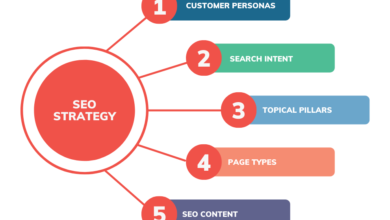
Choose 3–5 topic pillars that match revenue (not just traffic)
I’ve made the mistake of chasing high-volume keywords that never converted. Now, I validate pillars by asking: “If we rank for this, will the visitor actually buy our product?”
- Pillar 1 (Commercial): Managed Network Security (The service you sell).
- Pillar 2 (Informational/High Intent): Compliance Checklists (What your buyer searches for).
- Pillar 3 (Top of Funnel): Cybersecurity Trends (Broad awareness).
Create a keyword-to-page map (and prevent cannibalization)
Open a spreadsheet. This doesn’t need to be perfect—just consistent. Map one primary keyword to one URL. This prevents “cannibalization,” where two of your own pages fight for the same ranking.
| Page / URL | Primary Keyword | Intent | Action |
|---|---|---|---|
| /services/network-security | managed network security | Commercial | Update |
| /blog/network-security-checklist | network security checklist | Informational | Create |
| /blog/what-is-network-security | what is network security | Info (Basic) | Merge into Guide |
On-page SEO standards you’ll apply all year
Standardize this now so you don’t have to correct it 50 times later.
- Title Tags: Front-load the main keyword. Keep it under 60 characters. Write for clicks, not just bots.
- H1: Only one per page. Must match the Title Tag intent.
- URL Structure: Short, lowercase, hyphen-separated. (e.g.,
/blog/seo-strategy-template). - Internal Links: Every new post must link to a “money page” (Pillar 1).
- Alt Text: Describe images for accessibility, not keyword stuffing.
The 12 month SEO strategy template (quarter themes + month-by-month milestones)

This is the core of your strategy. You can customize this based on your resources. If you are a team of one, cut the deliverables in half—but keep the rhythm.
Constraints check: If you have limited dev time, prioritize critical errors (404s, noindex tags) in Q1 and save optimization tweaks for Q3.
| Month | Theme | Priority Deliverables | KPI to Watch |
|---|---|---|---|
| Month 1 | Foundation Audit | Tech audit, GSC setup, Keyword Map, fix critical errors. | Indexation Status |
| Month 2 | Quick Wins | Update top 10 existing pages, fix metadata, optimize Google Business Profile. | Click-Through Rate (CTR) |
| Month 3 | Content Launch | Publish first “Pillar” content, internal linking sprint. | Impressions Growth |
| Month 4 | Schema & Structure | Implement FAQ/Article schema, fix site speed. | Rich Snippet Appearance |
| Month 5 | Authority Building | Publish 1 linkable asset (data/tool), initial outreach. | Referring Domains |
| Month 6 | Mid-Year Review | Content gap analysis, re-optimize underperformers. | Keyword Rankings |
| Month 7 | Entity SEO | Update About page, author bios, social profiles. | Branded Search Volume |
| Month 8 | Content Scaling | Increase publishing frequency, repurpose content for social. | Organic Traffic Sessions |
| Month 9 | Conversion SEO | CRO on top pages, improve CTAs, update lead magnets. | Goal Conversions |
| Month 10 | Pruning & Merging | Delete/redirect zero-traffic pages, consolidate thin content. | Crawl Budget / Quality |
| Month 11 | Expansion | Target new adjacent topics or locations. | New Keyword Rankings |
| Month 12 | Annual Review | Full year reporting, next year strategy planning. | Revenue / ROI |
Q1 (Months 1–3): fix foundations and publish your first “win pages”
In Q1, I’d deprioritize expensive new content production if the site is broken. You can’t fill a leaky bucket.
- Fix the sitemap and robots.txt.
- Redirect broken 404 links to relevant pages.
- Refresh your “Top Pages” (pages already getting traffic) with better info and dates.
- Launch the first core “Pillar Page” to anchor your topic.
Q2 (Months 4–6): build topical authority + schema + first link momentum
Now we build. This is where consistency beats intensity.
- Publish support articles that link back to the Q1 Pillar Page.
- Add Schema Markup (Organization, LocalBusiness, Article) to help Google understand entities.
- Start light digital PR: pitch your unique data or expertise to industry blogs.
Q3 (Months 7–9): entity signals, conversion SEO, and content scaling
By now, traffic should be ticking up. Now we clarify who you are to search engines (Entity SEO).
- Enhance author bios with credentials to boost E-E-A-T.
- Add “About Us” schema and cite external sources.
- Focus on CRO: Are those visitors actually filling out forms?
Q4 (Months 10–12): expand, update, and future-proof the system
The year ends with cleanup and expansion. Don’t be afraid to delete content.
- Decision Tree: If a page gets impressions but no clicks → Rewrite Title. If it gets clicks but no leads → Fix CTA. If it gets neither → Delete or Redirect.
- Identify adjacent markets for next year.
How I run the month: a repeatable execution workflow (content, technical, and links)

Strategies die in the daily grind. To keep this alive, I treat every month like a sprint. Here is my personal workflow:
- Review Data (Day 1): Look at GSC. What went up? What tanked? Write down 3 hypotheses.
- Prioritize: Pick the top 3 actions that move the needle. Don’t try to do 10 things.
- Create Content Briefs: Outline the structure, intent, and headings.
- Draft & Production: This is where tools help. I use an AI article generator to speed up the drafting phase, but I always enforce a strict human editorial review for accuracy and tone.
- On-Page QA: Check titles, headers, and internal links before publishing.
- Tech Scan: Run a quick crawl to ensure no new errors appeared.
- Internal Link Sprint: Go back to old posts and link to the new one.
- Promotion: Share via email and social.
- Report: Update the KPI sheet.
Monthly checklist (copy/paste)
Time estimate: 2-4 hours per week
- [ ] Tech: Check GSC “Index Coverage” for new errors (30 mins).
- [ ] Content: Update 1 old post with new data/examples (1 hour).
- [ ] Create: Draft and publish 1 new support article (Half-day).
- [ ] Links: Add 3 internal links from high-authority pages to new content (30 mins).
- [ ] Distribute: Share new content on LinkedIn/Twitter (15 mins).
A beginner-safe link strategy (earned links, not shortcuts)
Please, don’t buy links on Fiverr. It works until it burns you. Instead:
- Create Linkable Assets: Stats pages, calculators, or free templates.
- Partner Swaps: Ask partners/suppliers for a link on their “Partners” page.
- Help a Reporter Out (HARO/Connectively): Answer journalist queries.
- Local Citations: Essential for local businesses (Yelp, Chamber of Commerce).
- Avoid: Private Blog Networks (PBNs) and site-wide footer links.
AI-aware SEO and rising content formats (what to add so your pages get cited and reused)
Search is changing. AI Overviews (formerly SGE) and chatbots look for structured, authoritative answers. They don’t just read text; they parse data. To position your site as a source, you need to use an SEO content generator mindset: structured, data-rich, and formatted for machines and humans.
AI-friendly page structure: TL;DR, anchors, sources, and methods
If I can’t cite it, I don’t claim it. That’s my rule. AI engines prioritize content that looks verified.
- TL;DR Summaries: Put the answer right at the top.
- Named Anchors: Use ID tags in your HTML so AI can jump to specific sections.
- Citations: Link to primary sources. It builds trust.
- Methodology: If you share a stat, explain how you got it.
Beyond blog posts: the 5 assets I’d prioritize for a business site
Text is great, but tools earn links. Here is what I am seeing work right now:
- Calculators: (e.g., “ROI Calculator”). High utility, earns passive links.
- Templates/Checklists: (e.g., “SaaS Onboarding Checklist”). People download and share these.
- Comparison Tables: Honest comparisons of Product A vs. Product B.
- Original Data Reports: Survey your customers and publish the stats.
- Infographics: Visual summaries of complex concepts.
Measurement and adaptation: dashboards, reporting cadence, and keeping the roadmap “living”

An SEO strategy is a living document. Google updates its algorithm thousands of times a year. Your plan must adapt.
| Cadence | What I Check | Actions |
|---|---|---|
| Weekly | GSC Impressions, Critical Errors | Spot check for sudden drops or tech failures. |
| Monthly | Traffic, Leads, Keyword Rankings | Update content plan. If something is winning, double down. |
| Quarterly | Strategy Review, Competitive Landscape | Adjust the next quarter’s pillars. Use an automated blog generator to scale winning topics efficiently. |
The “signal review” meeting agenda (30 minutes)
Keep this meeting blameless and focused on learning.
- Wins (5 mins): What content performed best? Why?
- Losses (5 mins): What didn’t rank? Was it intent or quality?
- Hypotheses (10 mins): “We think updating X will improve Y.”
- Next Actions (10 mins): Assign owners and deadlines.
Common mistakes (and fixes) when using a 12-month SEO roadmap

I’ve made these mistakes so you don’t have to.
- Mistake: Starting content before technical fixes.
Why it hurts: Great content won’t rank if Google can’t crawl it.
Fix: Dedicate Month 1 strictly to audits and cleanup. - Mistake: Chasing volume instead of intent.
Why it hurts: You get traffic but no leads.
Fix: Prioritize “bottom of funnel” keywords first, even if volume is low. - Mistake: “Set and Forget” mentality.
Why it hurts: Content decays. Competitors update.
Fix: Schedule quarterly “refresh” sprints for old content. - Mistake: Ignoring internal links.
Why it hurts: Authority gets stranded on one page.
Fix: Every time you publish, add 3 links from older posts to the new one. - Mistake: Over-reliance on raw AI output.
Why it hurts: It reads generic and lacks unique insight.
Fix: Use AI tools for structure and drafting, but inject human examples and data.
Mistake-to-fix checklist (5–8 items)
- Fix broken 404s before writing new posts.
- Target keywords with “commercial intent” first.
- Update old content every 6 months.
- Link internally immediately after publishing.
- Fact-check all AI-generated drafts.
FAQs + summary: what to do next with your 12 month SEO strategy template
Why use a 12-month SEO strategy template instead of ad-hoc efforts?
Ad-hoc SEO is reactive and scattered. A 12-month template aligns your work with business goals, allows for proper budgeting, and gives strategies enough time to compound. It turns SEO from a “black box” into a managed project.
What are common quarterly themes within a 12-month SEO roadmap?
Typically, they flow logically: Q1 is for Foundation (Audits), Q2 is for Content & Schema, Q3 is for Authority (Links & Entity), and Q4 is for Scale & Optimization. This sequence ensures you aren’t building a house on sand.
How do AI search trends change what SEO content should include?
AI search demands structure. Content should now include TL;DR summaries, clear methodology sections, direct answers in headers, and verifiable citations. It’s about being the most trustworthy answer, not just the longest.
What content formats are rising beyond traditional blog posts?
Interactive and visual assets are winning. Calculators, downloadable templates, original data studies, and infographics often earn more backlinks and engagement than standard text articles because they provide immediate utility.
Your Next Steps
If you do nothing else this week, start here:
- Download/Copy this roadmap into a Google Sheet or Notion doc.
- Set your Month 0 baselines (Traffic, Conversions, Rankings).
- Choose your top 3 Topic Pillars based on revenue.
- Schedule your first monthly “Signal Review” meeting.
- Ship your first 2 optimized pieces of content.
SEO is a marathon, but you run it one mile at a time. Good luck.