AI content creation best practices for 2026: how I scale automated content without losing quality

When I first tried to scale content production using AI a few years ago, I thought the goal was simply volume. I ramped up to 20 posts a week, sat back, and watched my traffic metrics. For a month, it looked like magic. Then, the engagement metrics tanked, and the corrections started piling up. I was scaling noise, not value.
In 2026, the game is entirely different. We aren’t just fighting for ten blue links anymore; we are optimizing for AI Overviews, managing agentic workflows that run while we sleep, and defending our brand against the rising tide of “AI slop.” Scaling is technically easier than ever, but building a system that maintains trust, accuracy, and brand voice is harder.
This isn’t a theoretical discussion about the future of AI. This is the exact newsroom-grade framework I use today to ship high-quality, intent-matched content at scale. Below, I’ll break down my end-to-end workflow, my specific tactics for Generative Engine Optimization (GEO), and the quality gates I refuse to automate.
What changed in 2026 (and why “AI slop” is now a business risk)

If you are still operating with a 2024 mindset—prompting a chatbot and pasting the result into WordPress—you are already behind. The infrastructure of content creation has shifted fundamentally.
Three specific technologies have redefined the baseline for U.S. businesses this year:
- Agentic AI: These aren’t just chatbots; they are autonomous systems capable of multi-step workflows. By 2026, over 30% of new applications are expected to incorporate built-in autonomous AI agents . They can research, draft, and format, but they need strict boundaries.
- Multimodal AI: We can now generate text, images, and video from a single context window. This creates consistency opportunities we’ve never had before, but also consistency risks.
- Generative Engine Optimization (GEO): Optimizing for Google’s AI Overviews is now as critical as traditional on-page SEO. With AI Overviews appearing in over 50% of U.S. desktop search results , being cited by the AI is often more valuable than ranking #4.
However, this ease of creation has birthed a massive problem: “AI slop.” Named the Word of the Year in 2025 , slop refers to low-effort, low-value automated content that clogs search results. Platforms are actively penalizing it, and users are learning to ignore it. My entire strategy is built around using tools like a high-quality SEO content generator not to create slop, but to build a knowledge base that withstands scrutiny.
Here is the reality check: Automation helps me draft 80% faster, but it creates a new bottleneck called “verification.” If I don’t catch a hallucinated stat or an off-brand tone, the damage to my reputation is instant.
My end-to-end workflow: AI content creation best practices you can repeat every week

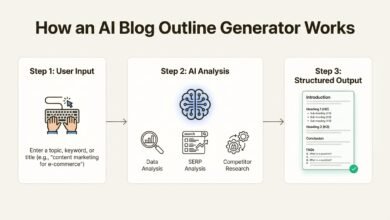
I treat my content operation like a manufacturing line for information. Every piece of content goes through the exact same stages. This standardization allows me to use an AI article generator effectively because the machine knows exactly what constraints it must work within.
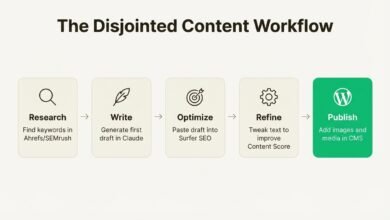
Here is the weekly workflow I use to maintain control while scaling:
| Stage | Input (My Job) | AI Task (Agent/Tool) | Human Check (My Job) | Outcome |
|---|---|---|---|---|
| 1. Strategy | Target keywords, intent analysis, POV | Topic clustering, gap analysis | Approve intent match | Approved Topics |
| 2. Briefing | Audience persona, unique angle, key sources | Draft detailed outline & headers | Verify structure & flow | The Brief |
| 3. Drafting | The Brief + Tone Guidelines | Generate full draft (section by section) | Spot check for “hallucinations” | First Draft |
| 4. Editing | Style guide, fact-checking rules | Suggest readability fixes, grammar | Verify facts, sources, voice | Final Polish |
| 5. SEO/GEO | Target entities, internal links | Generate meta, schema, formatting | Check definition clarity | Ready to Publish |
Step 1: Start with intent, not volume (what the page must accomplish)
I used to chase “best” keywords because they had high volume, only to realize later that the search engine results page (SERP) was dominated by how-to guides. I was writing the wrong format for the user’s intent.
Before I generate a single word, I check the SERP. My rule of thumb is simple: If the top results are mostly guides, I don’t publish a tool list. If the top results are definitions, I don’t write a 3,000-word opinion piece. I look at the query language and competitor page types to decide if I’m building a calculator, a checklist, or a deep-dive article.
Step 2: Build a brief the AI can’t misunderstand (audience, angle, sources, constraints)
The biggest lie in AI content is that you can just use a headline as a prompt. That is how you get generic fluff. I spend about 15 minutes per article building a brief because it saves me an hour of editing later.
Here is the brief structure I use (feel free to copy/paste this into your workflow):
- Target Audience: (e.g., “Mid-level Marketing Ops Managers in SaaS”)
- Core Problem: (e.g., “They have too much data and no insights”)
- The Promise: (e.g., “By the end of this post, they will have a 3-step dashboard template”)
- Unique Angle: (e.g., “Focus on ‘less is more’ rather than ‘track everything'”)
- Constraints: (e.g., “No fluff, no ‘in today’s digital world’ intros, max 1500 words”)
- Required Entities/Keywords: (List them)
Step 3: Prompting that produces structure (and reduces rework)
I never use a “one-shot” prompt for a full article. It almost always degrades in quality halfway through. Instead, I use structured prompting. I ask the AI to generate the outline first. Once I approve the outline, I prompt it to write section by section.
My prompts usually look like fragments of a conversation:
- “Based on the approved brief, write the Introduction. It must open with a hook about [specific pain point]. Do not use rhetorical questions.”
- “Now write the section on ‘Workflow Automation’. Include a bulleted list of benefits. Reference [Stat X] from the notes.”
This iterative approach keeps the AI focused and prevents it from wandering off-topic.
Step 4: Edit like a newsroom: accuracy, clarity, usefulness, and voice
Here is the part people skip when they get lazy, and it’s exactly where I got burned once. I published a post where the AI invented a statistic about market growth. A reader called it out on LinkedIn. It was embarrassing.
Now, my editing pass follows a strict order:
- Fact Check: I highlight every number, date, and name. If I can’t verify it, I cut it or mark it .
- Structure Check: Does the logic flow? Did we skip a step in the “how-to”?
- Voice Check: Does this sound like a human expert, or a robot thesaurus? (I delete words like “delve,” “tapestry,” and “landscape” on sight).
Step 5: Publish with a “definition of done” (SEO basics + distribution plan)
I don’t hit publish until the article passes my “Definition of Done.” It prevents that nagging feeling that I missed something.
- Title & Meta: Optimized for CTR, not just keywords.
- Headings: Clear hierarchy (H1 -> H2 -> H3).
- Internal Links: At least 3 links to relevant product or hub pages.
- Visuals: Alt text is descriptive and accurate.
- Mobile Check: I preview it on my phone to ensure paragraphs aren’t walls of text.
GEO in 2026: on-page SEO that earns visibility in AI Overviews

We used to optimize for 10 blue links. Now, we are optimizing to be the source that the AI summarizes. Generative Engine Optimization (GEO) is the practice of structuring content so that Large Language Models (LLMs) and search engines can easily parse, understand, and cite it.
If your content is unstructured blobs of text, the AI will ignore it. If it is structured, factual, and authoritative, you increase your odds of being the citation. Here is how I view the difference:
| Feature | Traditional SEO | GEO (AI Overviews) |
|---|---|---|
| Goal | Rank #1 on the page | Be cited in the AI summary |
| Content Structure | Long-form, keyword density | Concise answers, direct definitions |
| Authority Signal | Backlinks | Contextual relevance & citations |
| Key Tactic | Skyscraper technique | Answer Engine Optimization (AEO) |
Formatting patterns that AI summaries tend to pull (and how I use them)
I’ve noticed that AI Overviews love structure. They crave certainty. To tap into this, I use specific formatting patterns:
- The Definition Box: I start complex sections with a direct answer. “Agentic AI is a system that…”
- Ordered Lists: Step-by-step instructions are highly citeable.
- Data Tables: AI models can easily read and summarize tabular data (like the one above).
- Pros/Cons Lists: These offer balanced viewpoints, which AI algorithms often favor for neutrality.
Beginner-friendly schema and SERP hygiene (only what’s worth doing)
You don’t need to be a developer to win here. If you only do two things, ensure you are using Article Schema (usually built into your CMS) and consider FAQ Schema for your Q&A sections. This code on the backend screams to the search engine: “Here is the answer to that specific question.” It makes indexation cleaner and helps the AI understand the relationship between your content and the user’s query.
Multimodal and personalization: turning one idea into a full content system

One of my biggest efficiency unlocks this year has been multimodal repurposing. Instead of writing a blog post, then writing a separate script for a video, and then a separate LinkedIn post, I start with one core document.
With multimodal AI, I can take my approved brief and draft the blog post, a corresponding image prompt, and a video script simultaneously. This ensures the message doesn’t drift. I use it to repurpose, not to flood every channel with spam. A typical repurposing chain looks like this:
Core Article → LinkedIn Carousel (Summary) → Newsletter (Personal Take) → Short Video (Key Insight).
My “single source of truth” rule (so formats don’t contradict each other)
I have a hard rule: The core article brief is the single source of truth. All statistics, quotes, and product claims live there. If I update a stat in the blog post, I must update the source document. This prevents the embarrassment of a video citing 2024 data while the blog post cites 2026 data. Consistency builds trust; contradiction destroys it.
Quality, trust, and compliance: how I avoid “AI slop” and protect the business

Trust is the scarcest asset in 2026. With so much AI slop—mass-produced, low-quality content—flooding the web, being the brand that publishes accurate, verified info is a massive competitive advantage. I’d rather publish two great pieces a week than ten mediocre ones.
To enforce this, I use a Quality Scorecard for every piece. If it scores a zero in any category, it doesn’t go live.
| Criteria | What I Look For (0-2 Points) |
|---|---|
| Accuracy | Are all stats/claims verified with a primary source? |
| Specificity | Does it use specific examples vs. generic advice? |
| Originality | Does it add a new angle or data point? |
| Voice | Does it sound like us (not a generic robot)? |
| Helpfulness | Can the user actually do something after reading? |
Human-in-the-loop checkpoints I won’t automate (even in 2026)
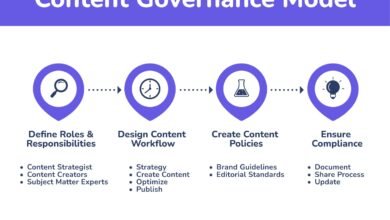
Some things simply cannot be automated if you want to stay in business. If a piece of content could get us sued, lose customer trust, or violates compliance, a human owns it.
- Legal/Compliance Claims: AI cannot judge legal risk.
- Financial/Medical Advice: The stakes are too high for hallucinations.
- Final Voice Polish: AI struggles with sarcasm, empathy, and cultural nuance.
Provenance and IP basics (what to track, where to store it, why it matters)
Future-me (and legal) will thank me for this: I archive the “provenance” of my content. This means I save the original prompt, the AI draft, and the human edit history. Why? Because in a world of copyright disputes and deepfakes, being able to prove how you created content and that a human reviewed it is your safety net. I keep it simple: a folder with the version history for every published URL.
Operate and improve at scale: metrics, automation, mistakes, FAQs, and next steps

Once you have the workflow, the goal is to turn it into a machine. This is where tools like a bulk article generator or an automated blog generator become powerful—provided you have the governance in place.
But how do you know if it’s working? I don’t rely on gut feel. I look at a dashboard.
The metrics dashboard I actually use (and what each metric tells me to do)
I check these metrics at different frequencies to keep my sanity. I don’t overreact to daily fluctuations.
| Metric Type | Metric | Frequency | Action Trigger |
|---|---|---|---|
| Leading | Indexation Rate | Weekly | If low, check technical SEO/sitemap. |
| Leading | Impressions | Weekly | If dropping, refresh content or titles. |
| Lagging | CTR | Monthly | If low, rewrite titles and meta descriptions. |
| Lagging | Time on Page | Monthly | If low, improve intro or add visuals. |
| Outcome | Conversions | Monthly | If low, check CTA placement. |
Common scaling mistakes (and how I fix them) — 7 items
- Publishing without a brief: Why it happens: Impatience. Fix: No brief, no draft. Period.
- Ignoring Content Refresh: Why it happens: Obsession with “new.” Fix: Dedicate 20% of the schedule to updating old posts.
- Unverified Stats: Why it happens: Trusting the AI too much. Fix: Mandatory link checks.
- Thin Content: Why it happens: Low word count prompts. Fix: Merge thin pages into comprehensive guides.
- Duplicate Topics: Why it happens: Poor calendar management. Fix: Check the existing library before approving new topics.
- Generic Intros: Why it happens: AI defaults to “In today’s world…” Fix: Write the intro yourself or prompt specifically for a hook.
- Keyword Stuffing: Why it happens: Old-school SEO habits. Fix: Optimize for natural reading and entities, not keyword density.
FAQs about automated content creation in 2026
What is agentic AI and why is it important for scaling content creation?
Agentic AI refers to AI systems that can autonomously execute multi-step workflows to achieve a goal, rather than just responding to a single prompt. For content scaling, this means an agent can research a topic, create an outline, and draft content with minimal intervention. Think of it as a junior assistant who does the heavy lifting, allowing you to focus on strategy and review.
How does multimodal AI improve content quality and efficiency?
Multimodal AI handles text, images, audio, and video simultaneously. This allows you to generate a blog post and its accompanying social media graphics or video script from the same core data. It improves efficiency by reducing context switching and improves quality by ensuring your message remains consistent across all formats, preventing brand fragmentation.
What is Generative Engine Optimization (GEO) and why does it matter?
GEO is the practice of optimizing content specifically for AI-powered search engines and answer engines (like Google’s AI Overviews). It matters because search behavior is shifting from clicking links to reading summaries. By structuring your content with clear definitions and data, you increase the likelihood of your brand being cited as the authoritative source in these summaries.
How can creators avoid producing “AI slop”?
To avoid “slop,” you must prioritize human oversight and intent. Never publish raw AI output. Use detailed briefs to constrain the AI, enforce a rigorous editing process (fact-checking and voice review), and ensure every piece of content solves a specific user problem rather than just filling a keyword gap. Quality must always trump volume.
How can content provenance and copyright be protected in AI-generated workflows?
Protecting provenance involves documenting the creation process. Keep records of your original prompts, the raw AI drafts, and the human edit logs. This “paper trail” proves human involvement, which is critical for copyright claims. Additionally, using internal version control and potentially digital watermarking tools helps establish the authenticity of your content assets.
Wrap-up: my 3-bullet recap + 5 next actions for this week
We’ve covered a lot, but if you take nothing else away, remember these three pillars:
- System over Speed: A verified workflow beats a fast, sloppy one every time.
- GEO is the New SEO: Structure your content to be read by machines so it can be trusted by humans.
- Trust is the Product: In an age of infinite content, verified accuracy is your differentiator.
Your 5 Next Actions for This Week:
- Audit your current workflow: Map out where you are losing time or quality.
- Create one “Golden Brief”: Build a template that includes audience, angle, and constraints.
- Test a GEO update: Take one existing high-traffic post and add clear definition boxes and data tables.
- Set up your scorecard: create a simple checklist for “Definition of Done.”
- Archive your history: Start a folder today for your next post to track its provenance.
If I were starting from zero today, I wouldn’t worry about publishing 100 posts. I would worry about building the machine that can publish 10 great ones perfectly. Start there.