Introduction: Marketing at scale without losing quality

We’ve all been there. It’s the third week of the month, the editorial calendar promised eight articles, but you’ve only shipped two. The backlog is growing, the sales team is asking for new collateral, and you are staring at a blinking cursor, wondering how to clone yourself. What I wish I knew earlier in my career is that the bottleneck isn’t usually a lack of ideas or even a lack of talent—it’s a lack of system.
For years, “scaling content” meant hiring more bodies or outsourcing to agencies that didn’t quite get our voice. Today, the equation has changed. By the end of this article, you will have a blueprint to build a content marketing automation engine that handles the drudgery—research, formatting, distribution, and reporting—so you can focus on the strategy and storytelling that actually converts.
This isn’t about replacing your marketing team with robots. It’s about giving your team the infrastructure to function like a modern newsroom: high velocity, strict standards, and zero chaos. Whether you are a solo founder or a Content Ops Lead at a growing SaaS, this is how you stop drowning in drafts and start building an asset library that works for you.
What is content marketing automation (and what it isn’t)?

Content marketing automation refers to the use of AI-powered tools and orchestration platforms to manage the entire content lifecycle—from ideation and creation to personalization, distribution, and optimization. It is the shift from manual, disconnected tasks to a streamlined workflow where data moves automatically between stages.
However, let’s be clear about what it is not. It is not a “one-click perfection” button. It is not a replacement for strategy. If you automate a bad process, you simply scale chaos. With approximately 88% of marketers now using AI tools for content creation , the competitive advantage isn’t in using the tools, but in how you string them together to maintain quality. The goal is to automate up to 80% of the repetitive tasks so your human intelligence can focus on the top 20% of high-leverage creative work.
Quick answer for beginners
Content marketing automation is a system that uses software to trigger, create, and manage content tasks without manual intervention for every step. It allows you to publish more frequently and consistently, provided you have human guardrails in place to ensure accuracy and voice.
Where automation helps most: volume, consistency, personalization

Automation shines where humans struggle: repetitive consistency and data processing at scale.
- Volume & Consistency: Instead of relying on willpower to post a blog every Tuesday, an automated workflow ensures briefs are generated, drafts are prepped, and social snippets are scheduled automatically.
- Personalization at Scale: This is the game-changer. Imagine a SaaS onboarding email sequence that triggers a specific case study based on the user’s industry. Companies excelling in personalization can see up to 40% greater revenue .
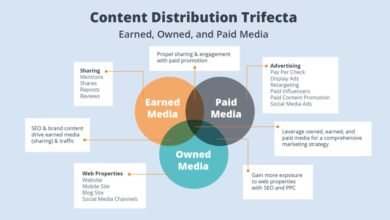
- Channel Efficiency: It allows you to take one core asset—say, a webinar—and automatically spin it into a blog post, five LinkedIn updates, and a newsletter segment without starting from scratch.
The end-to-end content marketing automation workflow (a newsroom-style framework)

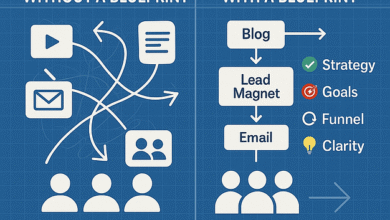
If you take nothing else from this guide, take this: Tools do not fix broken workflows. Before you subscribe to a single piece of software, you need to map the pipeline. In a high-performing content newsroom, the workflow is linear but cyclical.
Here is how I structure the lifecycle, distinguishing between what the machine does and where the human editor must step in:
| Lifecycle Stage | Automation Level | Tool Category | Human Checkpoint | Quality Criteria |
|---|---|---|---|---|
| 1. Research & Ideation | Medium | SEO/Keyword Tools | Strategy Approval | Does this align with business goals? |
| 2. Briefing | High | AI Brief Generators | Brief Review | Are the intent and angle unique? |
| 3. Drafting | High | AI Writers / LLMs | None (yet) | Structure, depth, and entities. |
| 4. Editing & QA | Low | Grammar/Plagiarism | Critical Human Edit | Accuracy, voice, and empathy. |
| 5. SEO & Publish | Medium | Optimization Tools | Final Sign-off | On-page checklist passed? |
| 6. Distribution | High | Social Schedulers | Performance Review | Right channel, right format? |
Step 1: Set strategy inputs (ICP, goals, topics, constraints)
Automation needs boundaries. If you don’t define who you are talking to, AI will write for everyone (which means it writes for no one). Before automating, document these non-negotiables:
- Ideal Customer Profile (ICP): Job title, pain points, and sophistication level.
- Business Goal: Are we driving traffic, leads, or brand awareness?
- Topic Clusters: The 3-5 core subjects you want to own authority in.
If you only do one thing: Write down your “Negative Constraints.” What do you never want to say? (e.g., “We never use the phrase ‘delve into'” or “We never give legal advice.”)
Step 2: Automate research and planning (keywords, briefs, internal links)
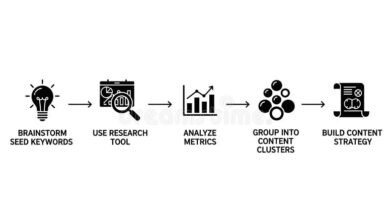
I use automation heavily here to escape the “blank page” syndrome. Instead of spending hours digging through SERPs, set up workflows that extract “People Also Ask” questions and competitor headings for your target keyword.
My workflow triggers a Standardized Content Brief creation the moment a topic is approved. This brief includes:
- User Intent: Informational, commercial, or transactional?
- Primary Keyword & LSI Keywords: For semantic relevance.
- Internal Linking Opportunities: Suggesting relevant existing articles.
- Source Requirements: URLs of studies or data we must cite.
Pro Tip: Adopt a “source-first” habit. Capture your citations and quotes before the drafting phase so the automation has facts to work with.
Step 3: Draft faster—without publishing raw AI output

This is where efficiency skyrockets, but risk increases. Use AI to generate the first draft based strictly on your brief. The goal is to get to a “B-” draft in minutes, not hours. You want a system that builds content section-by-section using your specific headers and research inputs.
For teams looking to streamline this specifically, tools like the AI article generator can turn a structured brief into a comprehensive draft that respects your formatting needs. However, the rule is simple: Human eyes must review every line. Use prompts that demand specific examples and forbid fluff.
My personal rule: If I can’t explain the concept to a new hire, the draft isn’t ready. If the AI writes something generic, I delete it and rewrite it with a specific operator’s perspective.
Step 4: Edit and QA with a checklist (accuracy, voice, originality)
Once the draft exists, shift from “creator” to “editor.” Automation can handle a first pass at grammar and style (e.g., checking for passive voice), but the final Quality Assurance (QA) is human.
Your QA Checklist:
- Fact Check: Are stats current? Are claims cited?
- Voice Check: Does it sound like us, or like a robot? (Look for words like “unleash,” “unlock,” “realm.”)
- Value Check: Did we add a new perspective, or just summarize Google?
- Compliance: Did we make any unverified promises?
Step 5: Publish, distribute, and refresh (automation loop)
Publishing isn’t the finish line. In a manual workflow, old content dies a slow death. In an automated one, you set up “decay detectors.” If a post’s traffic drops by 20% month-over-month, it should automatically trigger a ticket in your project management tool for a refresh.
For distribution, automate the repurposing. A published blog post should automatically trigger a draft tweet thread, a LinkedIn post, and a newsletter blurb for review. A realistic cadence for a small team using this method is 2 high-quality posts per week, plus one “Refresh Day” per month.
Building your AI stack for content marketing automation: the essential components

It is easy to get severe “shiny object syndrome” in this market. I recommend buying capabilities, not just brands. Your stack depends heavily on your team size and your CMS (often WordPress).
At the center of your stack, you need a “single source of truth” for your content operations—this acts as the brain. Then you need the hands (creation tools) and the voice (publishing tools). For those prioritizing organic search growth, a dedicated SEO content generator can serve as the engine that combines research, drafting, and optimization into one platform.
The Tool Categories:
| Category | Function | Common Pitfall |
|---|---|---|
Minimum viable stack (for a small team)
If I were starting from scratch today, I wouldn’t overbuy. Here is the week 1 setup:
- 1 Project Board: (e.g., Trello or Notion) to track status.
- 1 AI Writer: For drafting and outlining.
- 1 CMS: (Likely WordPress) for publishing.
- 1 Analytics Tool: (Google Search Console) to see what’s working.
Keep it simple. Consistency beats complexity every time.
Scale stack (when volume and channels expand)
As you grow, you add layers. You might integrate an orchestration tool like Zapier to automatically move approved briefs into your drafting tool. You might add a dedicated tool for dynamic personalization to serve different homepages to different industries.
The risk here is tool sprawl. When you have too many tools, ownership breaks. Assign a “Tool Owner” for each piece of software—someone responsible for ensuring it’s actually being used and integrated correctly.
Governance: keep automated content authentic, trustworthy, and on-brand

The biggest fear I hear from stakeholders is, “Will we sound like a bot?” or “What if the AI lies?” These are valid fears. The solution is Governance. You need a policy before you need a prompt.
Consumers are demanding transparency; surveys suggest over 70% favor disclosure when content is AI-generated . Trust is your currency. If you lose it by publishing a hallucinated statistic, you may never get it back.
My baseline rules: sources, human accountability, and clear disclosures
Here are the non-negotiables I operate by:
- Human Sign-off is Mandatory: No content goes live without a named human editor reviewing it.
- Verify Every Stat: If the AI claims “80% of people do X,” a human must find the primary source URL.
- No Medical/Legal Advice: We block AI from giving advice that requires professional licensure.
- Consult Your Counsel: For disclosure, we state clearly: “AI-assisted drafting; human-edited and fact-checked.” (Note: This is not legal advice; check with your compliance team).
Brand voice system: examples, do/don’t, and prompt guardrails
Don’t just tell the AI to be “professional.” That means nothing. Feed your system Golden Examples—paragraphs from your best-performing articles that capture your exact tone.
Create a “Do vs. Don’t” list for your prompts:
- Do: Use short sentences. Use analogies. Use data.
- Don’t: Use passive voice. Use buzzwords like “synergy” or “paradigm.”
I also like to feed the system actual phrases our customers use in support tickets. It grounds the content in reality.
SEO execution at scale for content marketing automation (on-page, internal links, and publishing ops)

Scaling content often leads to “SEO fragility”—where you publish so fast you forget the basics. Automation should handle the hygiene factors so you don’t have to think about them.
Your workflow must include technical checks. Are we cannibalizing our own keywords? Are we linking to orphan pages? This is where an Automated blog generator fits into the ecosystem—not just writing words, but structuring the HTML, placing headers correctly, and ensuring the technical skeleton of the post is sound before a human polishes the prose.
On-page checklist I use before hitting publish
I keep this sticky note on my monitor. It takes 3 minutes to run through:
- Intent Match: Does the H1 promise what the user searched for?
- URL Slug: Is it short and keyword-rich? (e.g., `/content-automation-guide` not `/blog/2026/05/guide-v2`)
- Scannability: Are there bullet points in every scroll depth?
- Schema: Is Article or FAQ schema applied? (Schema = code that helps Google understand the page).
- Internal Links: Are there at least 3 links to other relevant pages?
A simple internal linking rule that scales
Internal linking is often the first thing to break at scale. Here is a simple rule you can give to any writer or bake into your SOPs:
The “Hub & Spoke” Rule:
- Every “Spoke” (specific blog post) must link back to the “Hub” (main pillar page).
- Every “Hub” must link to the 3 newest “Spokes.”
- Every article must link to one “Money Page” (pricing or demo).
For example, if you are writing about “Email Subject Lines” (Spoke), link back to “Email Marketing Guide” (Hub) and your “Email Software” (Product).
Measurement and continuous improvement: what I track (and how automation helps)

You can’t manage what you don’t measure. But don’t measure everything. Automation allows you to pull reports automatically, so you don’t spend Monday morning taking screenshots of Analytics.
I look at Content Velocity (are we shipping?) and Assisted Conversions (is it helping sales?). Aviatrix, for instance, reported quadrupling their content output after adopting an AI stack . But output means nothing without outcomes.
| Metric | What it tells you | Common Misread |
|---|---|---|
My monthly content ops review (30–60 minutes)
Once a month, I sit down with a coffee and review the machine. My agenda is simple:
- Wins: What were the top 3 posts? Why did they win?
- Decay: Which posts lost rankings? (Add to refresh queue).
- Gaps: What new keywords are competitors ranking for?
- Process: Where did the workflow get stuck?
This review ensures the automation serves the strategy, not the other way around.
Common mistakes in content marketing automation (and how I fix them)

I have made plenty of mistakes so you don’t have to. Here are the most common pitfalls I see in automated content operations.
| Mistake | What it breaks | The Fix |
|---|---|---|
Mistake #1–#3: Automation without standards, oversight, or ownership
If you don’t have a style guide, AI will invent one (and it changes every time). The fix is the Governance section above. Assign a “Editor-in-Chief”—even if that is you—who is the final gatekeeper. If no one owns the quality, the quality will drop.
Mistake #4–#6: Scaling content that doesn’t deserve to rank
More pages does not equal more traffic if the pages are thin. I’ve seen teams generate hundreds of glossary pages that provide zero unique value. Google calls this “scaled content abuse.”
The Fix: Ask, “Does this page deserve to exist?” If you have a thin post, upgrade it. Add a unique template, a custom graphic, or an expert quote. Turn a definition into a guide.
Mistake #7–#8: Forgetting distribution and refresh
Great content that no one sees is waste. Automation often focuses heavily on creation and neglects distribution. Ensure your workflow includes automated social scheduling. And don’t forget the refresh cycle—updating an old post is often higher ROI than writing a new one.
FAQs: content marketing automation, AI stacks, authenticity, and GEO
What is content marketing automation?
It is the strategic use of software to manage the content lifecycle—ideation, creation, editing, and distribution—to increase efficiency and consistency while reducing manual repetitive work.
How much of content workflows can be automated with current AI tools?
While reports suggest up to ~80% of marketing tasks can be automated , this refers to the volume of tasks, not the percentage of total effort. The heavy lifting of research, formatting, and drafting can be automated, but strategic thinking and creative oversight remain manual.
What types of AI tools should a content team invest in?
Start with a core system: a project management tool (Orchestration), a generative writing assistant (Creation), and a CMS (Publishing). Don’t buy specialized video or influencer tools until you have the basics mastering the written word.
How can I ensure automated content stays authentic and trustworthy?
Transparency and standards. Disclose AI assistance where appropriate, verify all data points with human eyes, and infuse “lived experience” (examples, anecdotes) that AI cannot fabricate.
What is Generative Engine Optimization (GEO) and why it matters?
GEO is the practice of optimizing content to appear in AI-generated answers (like Google’s AI Overviews). With AI Overviews appearing in ~52% of US desktop search results , GEO ensures your content is structured, authoritative, and citable so AI engines choose your brand as the source of truth.
Conclusion: my practical next steps to start content marketing automation this week
We have covered the workflow, the stack, and the governance needed to scale without chaos. Remember: automation is a force multiplier. It amplifies whatever process you currently have—good or bad.
If I were starting today, here is exactly what I would do:
- Create one Content Brief Template that forces you to define audience and intent before writing.
- Establish a “Pre-Publish Checklist” (3-5 items max) to catch quality issues.
- Pick a Minimum Viable Stack (Project Board + AI Writer + CMS) and ignore the rest for now.
- Run a Monthly Review to catch what’s working and what’s decaying.
The goal isn’t to publish a million words. It’s to build a machine that consistently delivers value to your audience, so you can stop stressing about the backlog and start thinking about the future.