How to hire an SEO audit consultant for next-gen tech (Hiring Technical Excellence in 2026)
I’ve been in rooms where stakeholders—usually a mix of anxious marketing managers and skeptical engineers—review an SEO audit they paid $5,000 for. The result? A 60-page PDF filled with generic warnings about meta descriptions, zero prioritization, and absolutely no buy-in from the development team. It’s what I call “PDF theater.” It looks like work, but it changes nothing.
Hiring an SEO audit consultant shouldn’t feel like gambling. For US businesses in 2026, the stakes are higher. You aren’t just fixing broken links anymore; you are optimizing for AI-driven search, Core Web Vitals that actually impact revenue, and visual search behaviors that are reshaping e-commerce. You need a partner who speaks the language of revenue to your CEO and the language of code to your Head of Engineering.
This guide isn’t a theoretical overview. It is the exact hiring framework and evaluation checklist I use to find consultants who deliver actionable, business-aligned roadmaps rather than just lists of problems.
What an SEO audit consultant actually does (and what I should expect to receive)

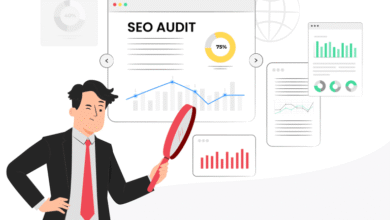
Think of a technical SEO audit as a structural engineering report for a high-rise building. An SEO audit consultant diagnoses the technical, content, and user experience issues that block organic growth. But diagnosis is only half the job. The real value lies in turning those findings into a prioritized roadmap that aligns with your business goals—whether that’s lowering Customer Acquisition Cost (CAC) or increasing qualified leads.
When I hire a consultant, I’m not paying for a tool export. I am paying for judgment. I expect them to filter the noise. If a tool flags 500 “issues” but only three of them are suppressing revenue, I want to know about those three.
Standard deliverables I expect:
- The Audit Report: A narrative document explaining the “why” behind the data.
- The Issue Backlog: A spreadsheet or Jira import file ready for developers.
- Priority Matrix: Items scored by Effort vs. Impact.
- KPI Model: Projections on how fixes translate to business metrics.
In-scope vs. out-of-scope: set boundaries early
Nothing sours a consulting relationship faster than mismatched expectations. I’ve seen projects stall because the client thought the consultant would fix the code, while the consultant thought they were only there to find the errors. Here is how I draw the line:
- In-Scope: Technical diagnostics (crawl/index), content quality assessment, competitive gap analysis, schema validation, performance benchmarking, and a prioritized statement of work for fixes.
- Out-of-Scope: Writing code (unless specified), manual content rewriting (usually separate), guaranteed #1 rankings (impossible), and full redesigns.
What “great” looks like: audit findings that lead to action
If you only remember one thing from this guide, let it be this: A great audit is defined by how much of it gets implemented. When evaluating sample work from candidates, I look for these traits:
- Prioritization is ruthless: They identify critical blockers versus “nice-to-haves.”
- Evidence is visual: Screenshots, code snippets, and graphs back up every claim.
- Reproducibility: Steps on how my team can see the error themselves.
- Ownership is assigned: They know which issues belong to dev, content, or marketing.
- Business Impact: They estimate the outcome (e.g., “Fixing this implementation roadmap item could recover ~15% of lost organic traffic”).
The technical excellence checklist: what I look for in an SEO audit consultant

You don’t need to be a developer to hire a good technical SEO, but you do need to know what questions to ask. The modern search landscape has moved beyond keywords into performance and user experience. If a consultant isn’t talking about Core Web Vitals or JavaScript rendering, they are stuck in 2018.
I use this table as a cheat sheet during interviews. It filters out the generalists from the technical experts.
| Metric/Area | Good Threshold | What Breaks It | How They Should Validate |
|---|---|---|---|
| LCP (Largest Contentful Paint) | ≤ 2.5 seconds | Large hero images, slow server response, render-blocking JS. | Field data (CrUX) + Lab data (Lighthouse). |
| CLS (Cumulative Layout Shift) | ≤ 0.1 | Images without dimensions, ads loading dynamically. | Visualizing layout shifts in DevTools. |
| INP (Interaction to Next Paint) | ≤ 200 milliseconds | Heavy JavaScript execution, unoptimized event listeners. | Real user monitoring (RUM) data. |
| Indexability | Close to 100% of valid pages | Rogue canonical tags, unintentional “noindex”, crawl loops. | Log file analysis & GSC Coverage report. |
Crawlability and indexability: can Google find and store my pages?
It sounds basic, but I still see massive sites with “orphan pages” that generate zero revenue simply because Google can’t find them. I ask candidates to explain the difference between crawlability (can the bot access the page?) and indexability (is the page allowed in the library?).
Common symptoms I look for include valid pages not appearing in search, or the wrong page ranking for a term (cannibalization). A strong consultant checks robots.txt for accidental blocks, reviews canonical tags to ensure we aren’t splitting authority, and validates the XML sitemap. I once worked with a SaaS brand where a single unchecked box in the CMS added a “noindex” tag to their entire blog. A simple audit caught it, but only because the consultant checked the source code, not just a tool.
Site architecture and internal linking: can users and bots navigate efficiently?
If I can’t find a product page in three clicks, Google probably struggles too. I expect a consultant to visualize my site architecture. Are we creating “topic clusters” that build authority, or are our best pages buried deep in the structure?
They should look at click depth and internal linking strategies. I want to see recommendations on how to link from high-authority parent pages to lower-authority child pages to pass value (link juice) down. This isn’t just SEO; it’s user experience.
Core Web Vitals and performance: measure, diagnose, and prioritize

Performance is no longer just a “dev thing.” Improving Core Web Vitals is directly linked to organic traffic gains—often cited as exceeding 20% in successful remediations .
I ask consultants: “Which data do you trust more, Lab data or Field data?” The correct answer is Field data (CrUX) because it reflects real user experiences. They need to diagnose LCP issues (often image compression or server speed), FID/INP (interactivity delays), and CLS (visual stability). If they just copy-paste PageSpeed Insights scores without analysis, that’s a red flag.
Structured data (schema) and SERP features: help search engines understand context
Structured data helps Google understand that a page is about a “Recipe” or a “Software Application,” not just a blob of text. This is crucial for winning rich results and SERP features like review snippets.
I verify that the consultant validates schema markup using Google’s Rich Results Test. I don’t want to hear “we added schema.” I want to confirm it’s valid, error-free, and eligible for the features we want to win.
Mobile usability, accessibility basics, and security signals
With mobile-first indexing, the desktop version of your site is secondary. I test this on my phone first. If I have to pinch-to-zoom, the audit failed. The consultant must verify viewport settings, tap target sizes, and responsive design integrity.
They should also cover HTTPS and security headers. While not purely SEO, site security impacts user trust. A “Not Secure” warning in Chrome kills conversions faster than bad copy ever could.
Next-gen audit signals: content quality, SERP intent, CRO, and voice/visual search readiness

The best consultants in 2026 are looking beyond the code. They merge technical SEO with user intent. I don’t just want more traffic; I want revenue. This means the audit must include a content audit that flags thin, duplicate, or helpful content issues and aligns pages with search intent.
Should SEO audits include conversion optimization (CRO)?
Yes. If you drive traffic to a broken page, you’re wasting money. I look for CRO in SEO audits that highlights obvious friction points. Integrating CRO strategies into SEO audits can raise conversions by approximately 25% .
What belongs in the audit:
- Identifying slow-loading forms.
- Flagging intrusive interstitials that block content (and hurt SEO).
- Recommendations for A/B testing key landing pages.
Voice and visual search: the “future-proofing” checks I ask for
With visual search optimization expected to influence ~20% of e-commerce queries by 2026 , this isn’t sci-fi anymore. I ask consultants to review our image SEO (using high-res formats, proper file names) and alt text—not just for accessibility, but for visual search engines like Google Lens. For voice search, I want to see if our content answers questions concisely, often utilizing FAQ schema.
How to hire an SEO audit consultant: my step-by-step hiring workflow

Hiring is a process of elimination. Here is the exact sequence I follow to hire a technical SEO consultant that fits my specific business needs.
Step 1: Define business goals and KPIs (before I talk to anyone)
Don’t worry if your analytics aren’t perfect, but you need a baseline. Before I send an email, I gather:
- Current organic traffic trends from GA4.
- Top performing pages by revenue/leads.
- Current SEO KPIs: conversion rate, organic revenue attribution, and keyword rankings for our top 5 products.
Step 2: Write a tight scope (so proposals are comparable)
Good consultants can’t quote accurately without context. I create a mini SOW (Statement of Work) or RFP that includes:
- Site Size: Number of pages (~500 or ~500,000?).
- CMS: Are we on WordPress, Shopify, or a custom headless setup?
- Access Levels: I clarify they will get read-only access to GSC/GA4 but no direct database access.
Step 3: Screen for proof (case studies, before/after, and implementation reality)
I treat SEO case studies with healthy skepticism. I don’t look at the graph going up; I look at the narrative. Did they find a specific technical unlocking mechanism? I ask: “What exactly did you change, and how did you verify the fix?” The best answers sound like engineering debugging stories, not magic.
Step 4: Interview questions I use to separate experts from talkers
Copy and paste these into your interview notes:
- “How do you prioritize fixes when dev resources are limited?” (Listen for: Business impact logic).
- “Show me an example of a recommendation that didn’t get implemented. Why?” (Listen for: Honesty and understanding of org dynamics).
- “How do you use AI-driven SEO audit tools to speed up analysis without missing edge cases?”
- “What are your ethical SEO standards regarding risky tactics?”
Step 5: Score candidates with a simple rubric (template)
I share this rubric with my stakeholders so we don’t argue over “gut feelings” later.
- Technical Depth (1-5): Did they spot the obvious issues in a preliminary glance?
- Communication (1-5): Can they explain “canonicalization” to our CEO?
- Business Alignment (1-5): Do they care about revenue or just rankings?
- Ethics (Pass/Fail): Any mention of guaranteed rankings is an automatic fail.
Step 6: Contracting and onboarding: what goes in the SOW
This is the boring part that prevents headaches later. The contract must list deliverables, the specific timeline, meeting cadence, and implementation support (e.g., “includes 2 hours of Q&A with the dev team”).
Tools and AI-driven analysis: what I expect a modern SEO audit consultant to use (and why it matters)

I expect modern consultants to leverage technology to be efficient. AI-driven analysis tools can cut manual review time by up to 40% , allowing the human expert to focus on strategy. AI is incredible for SERP analysis, clustering thousands of keywords by intent, and finding content gaps at scale.
However, I still want the consultant to show me the data trail. Tools like Kalema are excellent for acting on audit findings—specifically for generating high-quality, intent-matched content or analyzing existing pages—but the consultant must interpret the data. I ask them: “Which tools do you use for crawling vs. rendering?”
My minimum tool-stack checklist (without getting tool-obsessed)
If they can’t explain why they use a tool, I’m cautious. My expected stack:
- Crawler: (e.g., Screaming Frog, DeepCrawl) for deep site inspection.
- Forensic/Logs: Log file analyzer for seeing exactly how Googlebot behaves.
- Data Sources: GSC and GA4 are non-negotiable.
- Market Intelligence: Tools for keyword and competitor research.
Budget, timelines, and what “good value” looks like for a comprehensive SEO audit

In the US market, cheap audits are often the most expensive because you pay for them twice: once to get the bad advice, and again to fix it. SEO audit cost varies wildly, but typically reflects the complexity of your site (e.g., international domains, JavaScript frameworks).
How long should a comprehensive SEO audit take?
If I am promised a “full audit in 48 hours,” I ask what is being skipped. A comprehensive audit for a mid-sized site (~200 pages) typically takes around two weeks. This allows time for:
- Crawl setup and execution (checking render paths).
- Manual review of key templates (human eyes on screens).
- Data synthesis and prioritization.
- Report writing and roadmap creation.
Log file analysis or complex migrations will extend this timeline.
Common mistakes and red flags when hiring an SEO audit consultant (and how I avoid them)

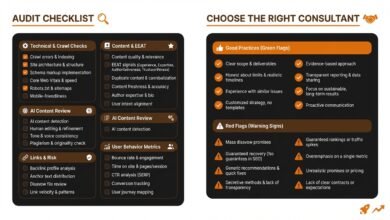
I’ve learned some of these the hard way. Here are the SEO consultant red flags that make me walk away immediately.
- “I guarantee #1 rankings.” Fix: Run. No one controls Google.
- “Here is a list of 5,000 errors.” Fix: Ask for the “Top 10” that impact revenue. Prioritization is the job.
- Secret Methodologies. Fix: Require white-hat SEO transparency. “It’s proprietary” usually means it’s risky.
- No Developer Empathy. Fix: Ask how they handle “wont-fix” feedback from engineering. If they get defensive, they won’t fit the culture.
How can I tell if a consultant uses ethical SEO practices?
Ethical SEO is about sustainability. If a tactic works today but risks a penalty tomorrow, it’s not a strategy; it’s a liability. I look for consultants who focus on transparent reporting and adhering to Google’s Search Essentials. They should report on metrics like organic traffic growth and conversion quality, not just vanity keyword positions.
FAQs + next steps: choose, onboard, and measure success after I hire an SEO audit consultant

You’ve done the research, now it’s time to act. Here are the final answers to the most common questions I get about this process.
What specific technical metrics should an SEO audit consultant evaluate?
They must evaluate Core Web Vitals metrics (LCP, CLS, INP), technical SEO metrics like crawl budget efficiency, status code errors (4xx, 5xx), HTTPS validity, and schema correctness. Always ask to see the raw data exports.
Why is AI-driven analysis important in a modern SEO audit?
AI-driven analysis allows consultants to process massive datasets—like analyzing SERP features for 10,000 keywords—faster than any human. It identifies content gaps and intent mismatches efficiently. But remember: AI detects; humans decide.
Should SEO audits include conversion optimization?
Absolutely. CRO, landing page evaluation, and UX testing ensure that the traffic you earn actually converts. I expect basic checks on form functionality, call-to-action clarity, and page load friction.
How long should a comprehensive SEO audit take?
Rule of thumb: Plan for a two-week SEO audit cycle for a standard business site. Complex enterprise sites may take a month. Speed is rarely a sign of quality here.
Your Next Steps:
- Day 1: Define your KPIs and gather access to GA4/GSC.
- Day 3: Draft your Scope/SOW using the checklist above.
- Day 7: Interview 3 candidates using the “listen for” questions.
- Day 14: Kick off the audit and schedule the debrief with your dev team.
- Post-Audit: Once you have your content roadmap, use tools like the Kalema AI article generator to execute on content gaps at scale while maintaining quality.
Hiring the right consultant is the first step toward building a predictable, high-performing organic growth engine. Good luck.